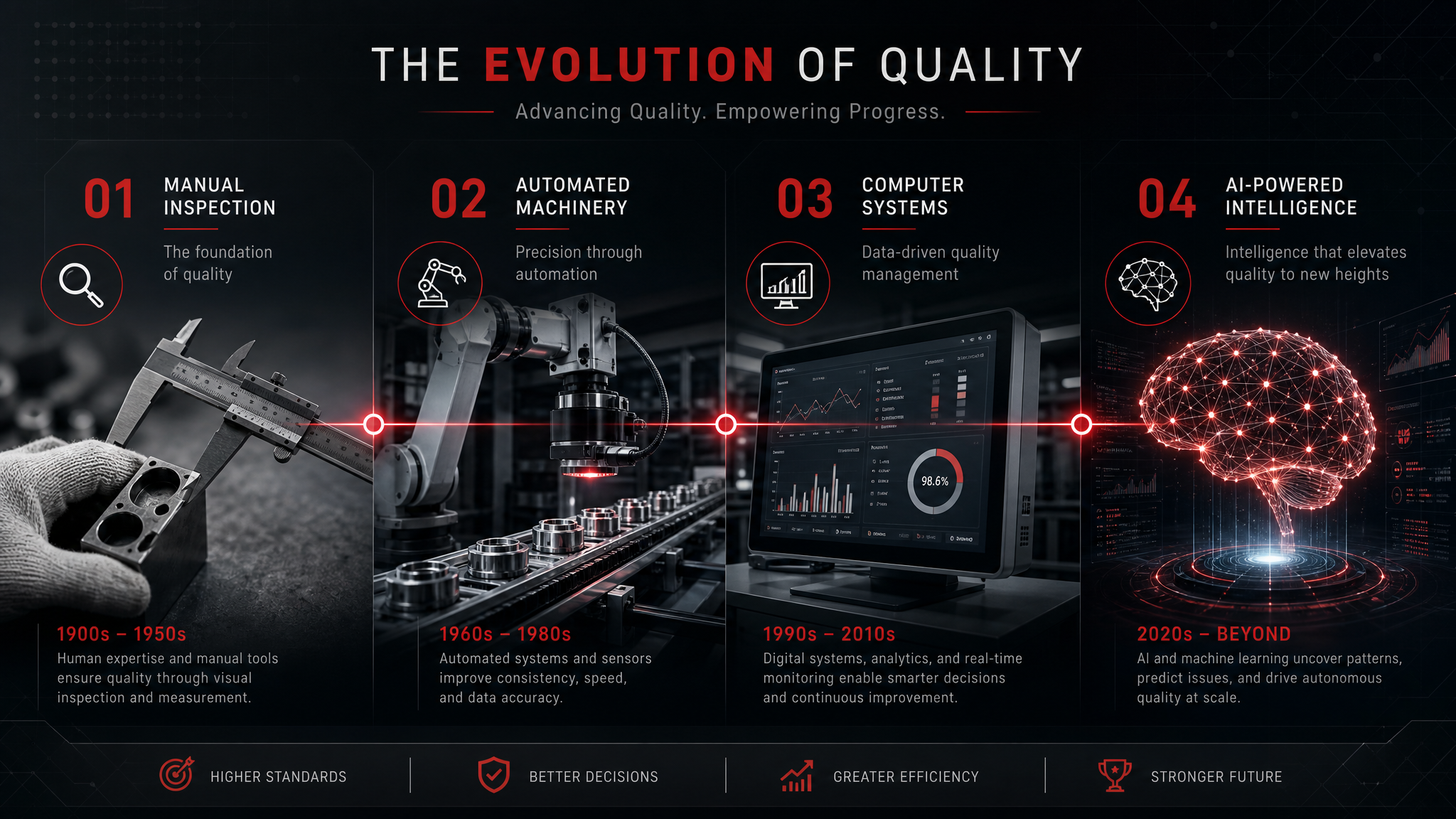
Real-Time SPC in the Age of Quality 4.0: From Manual Charts to Automated Process Control
Learn how Quality 4.0 transforms Statistical Process Control from periodic, manual charting into continuous, AI-enhanced monitoring that detects process drift before defects occur.
John Lee
Illustrative image generated using AI; any people depicted are not real individuals.
Statistical Process Control has been a cornerstone of quality management since Walter Shewhart first developed control charts at Bell Labs in the 1920s. For a century, the fundamental principles have remained sound — but the implementation has lagged behind available technology. Quality 4.0 finally brings SPC into the modern era.
The Problem with Traditional SPC
In most manufacturing facilities today, SPC looks remarkably similar to how it looked in 1990. An operator stops production, measures a sample of 3–5 parts using a micrometer or CMM, records the values on a paper form or spreadsheet, and plots the points on a control chart. This happens once per hour — or once per shift at many operations.
The limitations are clear: you are only seeing a tiny fraction of your actual production output. Between samples, the process could drift, produce hundreds of defective parts, and self-correct — and your SPC system would never know. According to InfinityQS, traditional manual SPC sampling captures less than 0.1% of production data in most operations.
Real-Time SPC: Continuous Quality Intelligence
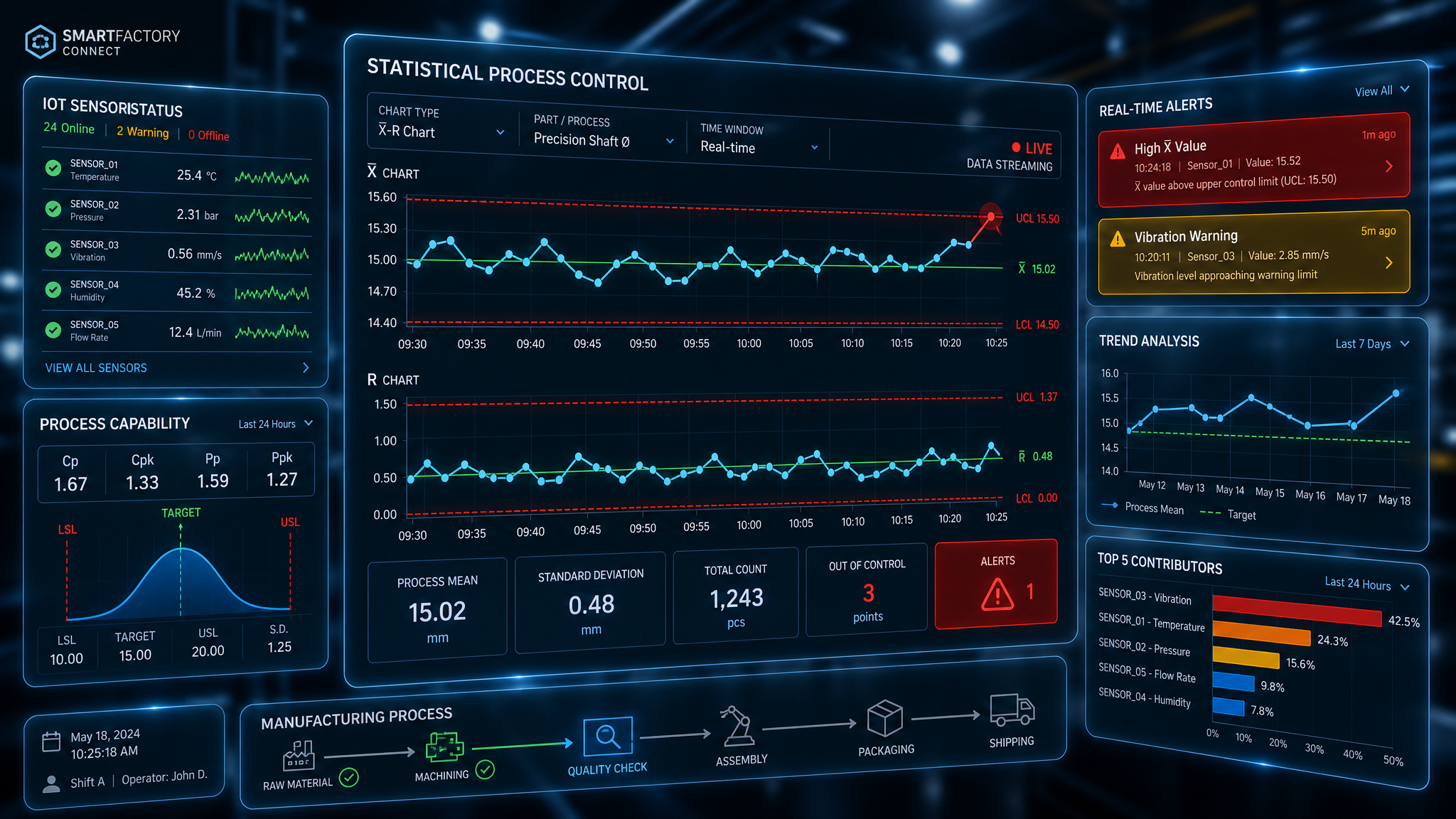
Real-time SPC replaces periodic sampling with continuous monitoring. IoT-connected sensors, inline gauges, and automated measurement systems capture data from every part — or at minimum, every few seconds. This data streams directly into SPC software that calculates control statistics, plots charts, and evaluates control rules in real time.
The Technology Stack
- Data Acquisition: IoT sensors (temperature, pressure, vibration, dimensional), inline vision systems, laser micrometers, and automated CMMs connected via OPC-UA, MQTT, or REST APIs.
- Edge Processing: Local compute nodes perform initial calculations (subgroup statistics, range values) to reduce network bandwidth and latency.
- SPC Engine: Cloud or on-premise SPC software calculates control limits, evaluates Western Electric rules, and generates alerts. Modern platforms support multiple chart types — X̄-R, X̄-S, ImR, p-charts, c-charts — automatically selected based on data characteristics.
- Alert and Response: When a rule violation is detected, alerts are sent via SMS, email, dashboard notifications, or machine integration signals. Some systems can automatically pause production when critical limits are breached.
AI-Enhanced Pattern Detection
Traditional SPC rules are powerful but limited to predefined patterns. AI-enhanced SPC adds a layer of machine learning that can detect complex, multi-variable patterns that no set of rules would catch. For example:
- Multivariate drift: Temperature and pressure may each be within spec individually, but their combined trajectory indicates an emerging problem.
- Cyclical patterns: Subtle periodic variations correlated with tool wear, shift changes, or raw material lot changes.
- Correlation analysis: Automatically identifying which upstream process parameters most strongly predict downstream quality outcomes.
A 2023 study published in Quality Engineering Journal found that AI-enhanced SPC detected process anomalies an average of 45 minutes earlier than traditional Western Electric rules, reducing average defect escape quantity by 72%.
Implementation: Start Where It Matters Most
You do not need to instrument every machine on day one. Start with your highest-risk or highest-cost processes — the ones where a process deviation creates the most scrap, rework, or customer impact. Prove the value on one line, then expand.
Integration with your QMS is essential. When real-time SPC detects a process shift, it should automatically log the event, trigger an investigation workflow, and link to corrective actions. This closed-loop approach ensures that SPC findings drive actual improvement — not just another alert that gets ignored.
Calculating the Business Case
The ROI of real-time SPC centers on three areas: reduced scrap (25–40% typical improvement), reduced inspection labor (automated data collection eliminates manual measurement time), and reduced customer complaints (earlier detection means fewer defective parts reach customers). For a manufacturing operation producing $10M in annual output with a 3% scrap rate, a 35% reduction in scrap represents $105,000 in annual savings — often exceeding the total cost of the SPC system implementation.
Frequently Asked Questions
What is real-time SPC and how does it differ from traditional SPC?
What Western Electric rules does AI-enhanced SPC monitor?
How much does real-time SPC reduce scrap rates?
About the Author
John Lee
Founder & Quality Systems Architect
John Lee brings over 20 years of hands-on experience in quality management across automotive, aerospace, and medical device manufacturing. As the founder of IntelligentQMS, he has helped organizations worldwide implement robust quality management systems that drive operational excellence.
Related Articles
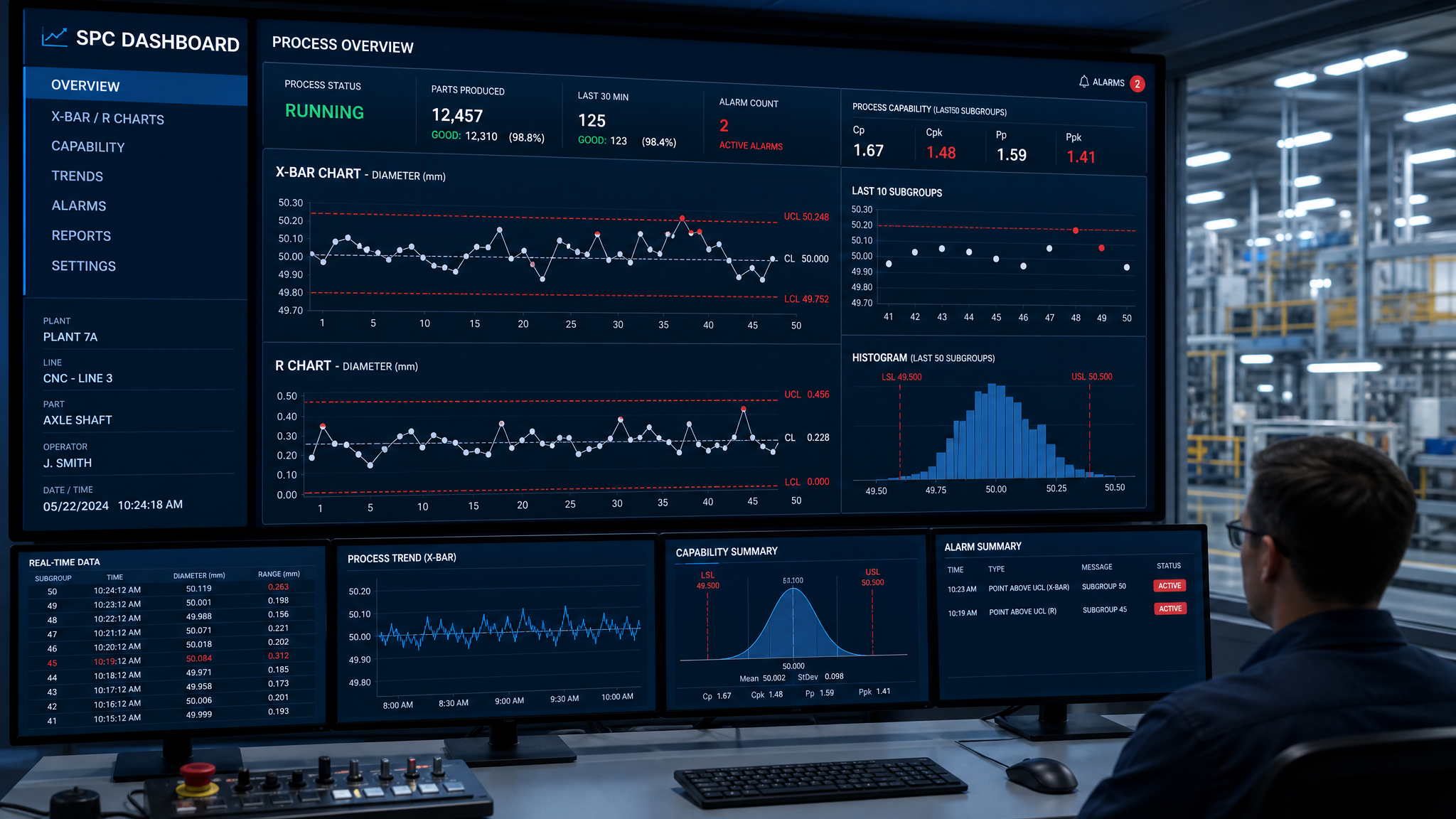
SPC and Control Charts: A Manufacturing Leader's Guide to Process Stability

IoT-Enabled Quality: How Connected Sensors Transform Manufacturing Quality