Quality 4.0 Maturity Model: Assessing Your Organization's Digital Quality Readiness
Use this five-level maturity model to evaluate where your quality operations stand on the Quality 4.0 spectrum — and build a practical plan to advance.
John Lee
Illustrative image generated using AI; any people depicted are not real individuals.
Before you can chart a course toward Quality 4.0, you need to know where you are today. A maturity model provides a structured framework for assessing your current state, identifying gaps, and prioritizing investments. Based on frameworks from ASQ, LNS Research, and real-world implementation experience, this five-level model covers the full spectrum of digital quality maturity.
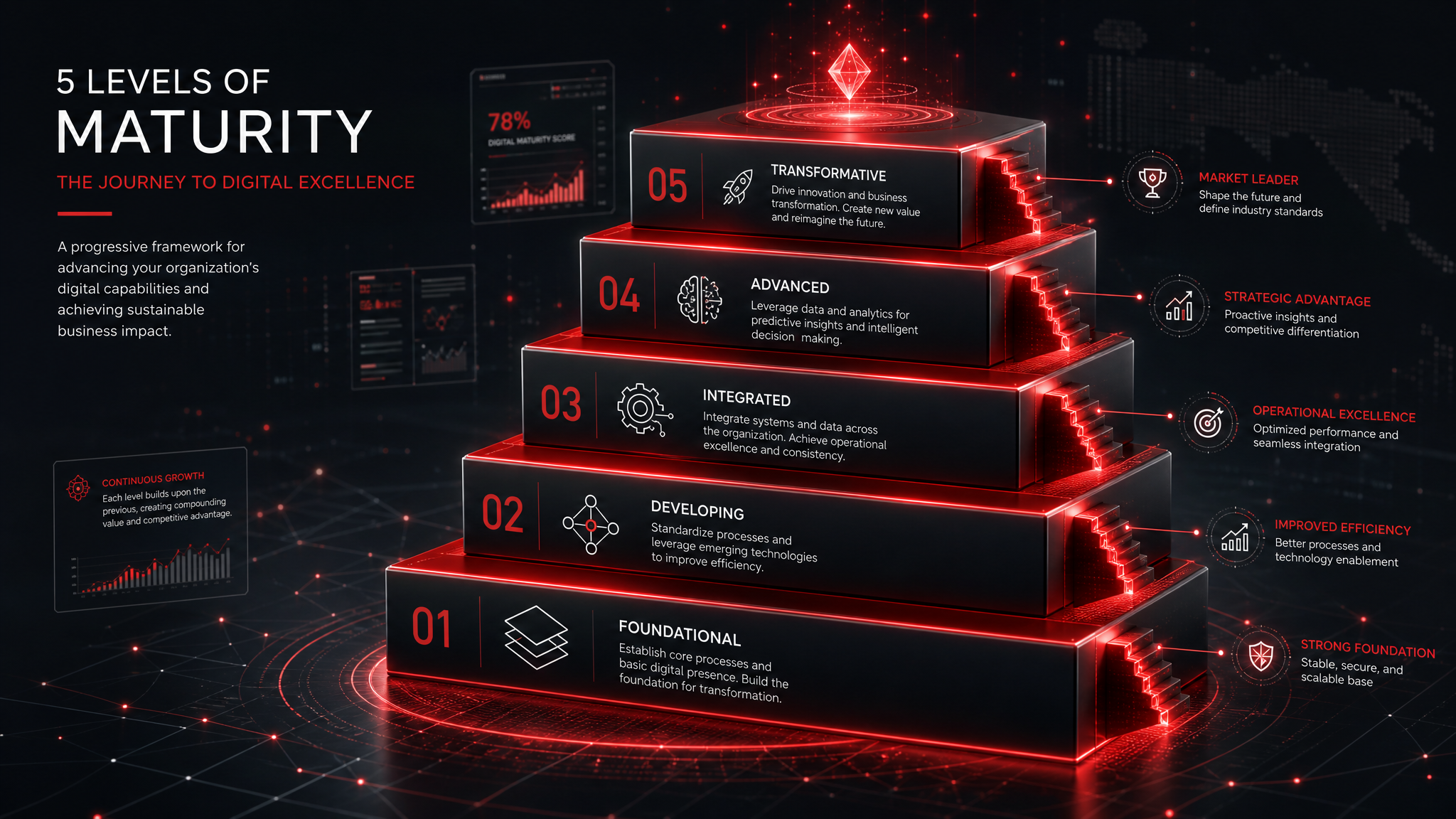
The Five Levels of Quality 4.0 Maturity
Level 1: Reactive (Paper-Based Quality)
At this level, quality management relies primarily on paper records, end-of-line inspection, and reactive problem-solving. Quality data is captured manually, stored in filing cabinets or disconnected spreadsheets, and analyzed infrequently — often only in response to customer complaints or audit findings.
Indicators: Paper-based inspection records, no centralized QMS software, quality metrics reviewed monthly at best, corrective actions tracked via email, and limited management visibility into quality performance.
Level 2: Managed (Basic Digital Tools)
Organizations at Level 2 have adopted some digital tools — typically a standalone QMS application, Excel-based SPC, or basic ERP quality modules. However, these tools operate in silos. Data is entered manually, integration between systems is limited, and analytics remain descriptive (backward-looking reports and dashboards).
Indicators: QMS software for document control and CAPA, manual data entry into SPC tools, periodic quality reports generated from exports, and limited real-time visibility. According to LNS Research, 58% of manufacturers operate at this level as of 2024.
Level 3: Defined (Integrated and Automated)
Level 3 marks the transition to connected quality. QMS, ERP, and manufacturing execution systems (MES) share data through integrations or APIs. Data collection is partially automated — sensors feed SPC systems directly, inspection results flow into the QMS automatically, and dashboards update in real time.
Indicators: Automated data collection from gauges and sensors, integrated systems sharing quality data, real-time dashboards with alert thresholds, standardized quality processes across sites, and regular data-driven management reviews.
Level 4: Predictive (AI-Enhanced Quality)
At Level 4, organizations leverage AI and machine learning to move from reactive and descriptive quality to predictive quality. Historical data trains models that forecast potential failures, predict process drift, and recommend preventive actions before defects occur. IoT sensor networks provide comprehensive process monitoring.
Indicators: ML models predicting quality outcomes, predictive maintenance integrated with quality, automated pattern detection in SPC data, AI-assisted root cause analysis, and digital twins for process simulation. BCG research shows these organizations achieve 30–50% lower COPQ.
Level 5: Autonomous (Self-Optimizing Quality)
The highest maturity level features quality systems that can self-correct without human intervention. Closed-loop control systems adjust process parameters in real time based on AI analysis, automated inspection systems make accept/reject decisions, and the quality system continuously learns and improves from new data.
Indicators: Closed-loop process control driven by AI, fully automated inspection with computer vision, self-adjusting control limits, autonomous supplier quality monitoring, and continuous model retraining. Fewer than 5% of manufacturers have reached this level today.
Assessing Your Organization: Six Dimensions
Rate your organization on each dimension using the 1–5 scale above:
- Data Infrastructure: How is quality data collected, stored, and governed? Are data sources connected or siloed?
- Analytics Capability: Are you doing descriptive reporting, diagnostic analysis, predictive modeling, or prescriptive optimization?
- System Integration: Do your QMS, ERP, MES, and SPC platforms share data in real time?
- Workforce Digital Skills: Can your quality team interpret data visualizations, use analytics tools, and work with AI-assisted insights?
- Leadership and Strategy: Does the executive team view quality as a strategic digital priority with a funded roadmap?
- Supply Chain Connectivity: Do you have real-time visibility into supplier quality performance?
Your lowest-scoring dimensions represent the highest-leverage improvement opportunities. Most organizations benefit from addressing data infrastructure and system integration first, as these enable all other Quality 4.0 capabilities.
Common Pitfalls at Each Level
The most frequent mistake is trying to jump from Level 1 to Level 4. Organizations that skip the foundation-building stages of Levels 2 and 3 — solid digital QMS, automated data collection, and system integration — find that their AI and analytics initiatives lack the data quality and infrastructure needed to succeed. A 2024 Deloitte study found that 70% of failed digital quality initiatives cited "insufficient data infrastructure" as the primary cause of failure.
Build sequentially. Each level provides the foundation for the next. The journey from Level 2 to Level 4 typically takes 18–36 months of focused effort.
Frequently Asked Questions
What are the levels of a Quality 4.0 maturity model?
How do I assess my organization's Quality 4.0 maturity?
What percentage of manufacturers have achieved Quality 4.0 maturity?
About the Author
John Lee
Founder & Quality Systems Architect
John Lee brings over 20 years of hands-on experience in quality management across automotive, aerospace, and medical device manufacturing. As the founder of IntelligentQMS, he has helped organizations worldwide implement robust quality management systems that drive operational excellence.
Related Articles
What Is Quality 4.0? Definition, Principles, and the Evolution from Quality 1.0 to 4.0
Building Your Quality 4.0 Roadmap: A Step-by-Step Implementation Framework