Predictive Quality Analytics: Using Machine Learning to Prevent Defects Before They Occur
Move beyond reactive quality management with predictive analytics. Learn how ML models trained on historical data forecast quality outcomes and enable preventive action.
John Lee
Illustrative image generated using AI; any people depicted are not real individuals.
Predictive quality analytics represents the most significant paradigm shift in Quality 4.0: moving from detecting problems after they occur to preventing them before they happen. According to a 2024 Deloitte study, manufacturers using predictive quality analytics reduced their cost of poor quality by an average of 35% — not by inspecting more thoroughly, but by producing fewer defects in the first place.
From Reactive to Predictive: The Quality Analytics Spectrum
Quality analytics operates at four levels of sophistication:
- Descriptive (What happened?): Traditional quality reports and dashboards. Scrap rates, PPM, COPQ trending. Valuable but backward-looking.
- Diagnostic (Why did it happen?): Root cause analysis, Pareto analysis, correlation studies. Helps explain failures but still reactive.
- Predictive (What will happen?): ML models that forecast quality outcomes based on current process conditions. This is where Quality 4.0 creates transformative value.
- Prescriptive (What should we do?): AI systems that not only predict problems but recommend optimal corrective actions and process parameter adjustments.
Building Predictive Quality Models: A Practical Framework
Data Preparation Is 80% of the Work
The most common reason predictive quality projects fail is not the algorithm — it is the data. Manufacturing data is notoriously messy: sensor gaps, unit inconsistencies, time alignment issues between data sources, and unlabeled quality outcomes. Invest heavily in data engineering before touching any ML framework.
Key data preparation steps include: aligning timestamps across data sources (sensors often run on different clocks), creating time-lagged features (today's furnace temperature affects tomorrow's hardness test results), handling missing values through domain-appropriate imputation, and encoding categorical variables like material lot, operator, and machine ID.
Feature Engineering: The Quality Engineer's Advantage
This is where domain expertise matters more than data science skill. A quality engineer who understands the physics of the process can create features that dramatically improve model performance. For example, calculating the temperature gradient (rate of change) rather than using raw temperature, or creating a "time since last tool change" feature for machining processes. Research from MIT's Laboratory for Manufacturing and Productivity showed that domain-informed features improved quality prediction accuracy by 25–40% compared to purely automated feature selection.
Model Selection and Training
For most manufacturing quality prediction tasks, gradient boosted tree models (XGBoost, LightGBM) provide the best balance of accuracy, interpretability, and deployment simplicity. Train multiple model types, compare their performance on your validation set, and select based on both accuracy and explainability — your quality team needs to understand why the model is making predictions, not just trust a black box.
Real-World Applications and Results
- Injection Molding: A medical device manufacturer trained a predictive model on 14 process parameters (temperatures, pressures, cycle times) to predict dimensional outcomes. The model achieved 94% accuracy in predicting out-of-spec parts 3 minutes before they were produced, enabling proactive parameter adjustment.
- Heat Treatment: An aerospace supplier used LSTM neural networks to predict post-treatment hardness values from furnace telemetry. Prediction accuracy within ±2 HRC enabled them to eliminate 60% of destructive testing — saving $400,000 annually in testing costs and material waste.
- Assembly Operations: An electronics manufacturer predicted solder joint reliability from reflow oven profiles, component placement accuracy, and paste volume measurements. The model identified 85% of potential field failures during production, reducing warranty costs by 28%.
Deployment and Monitoring
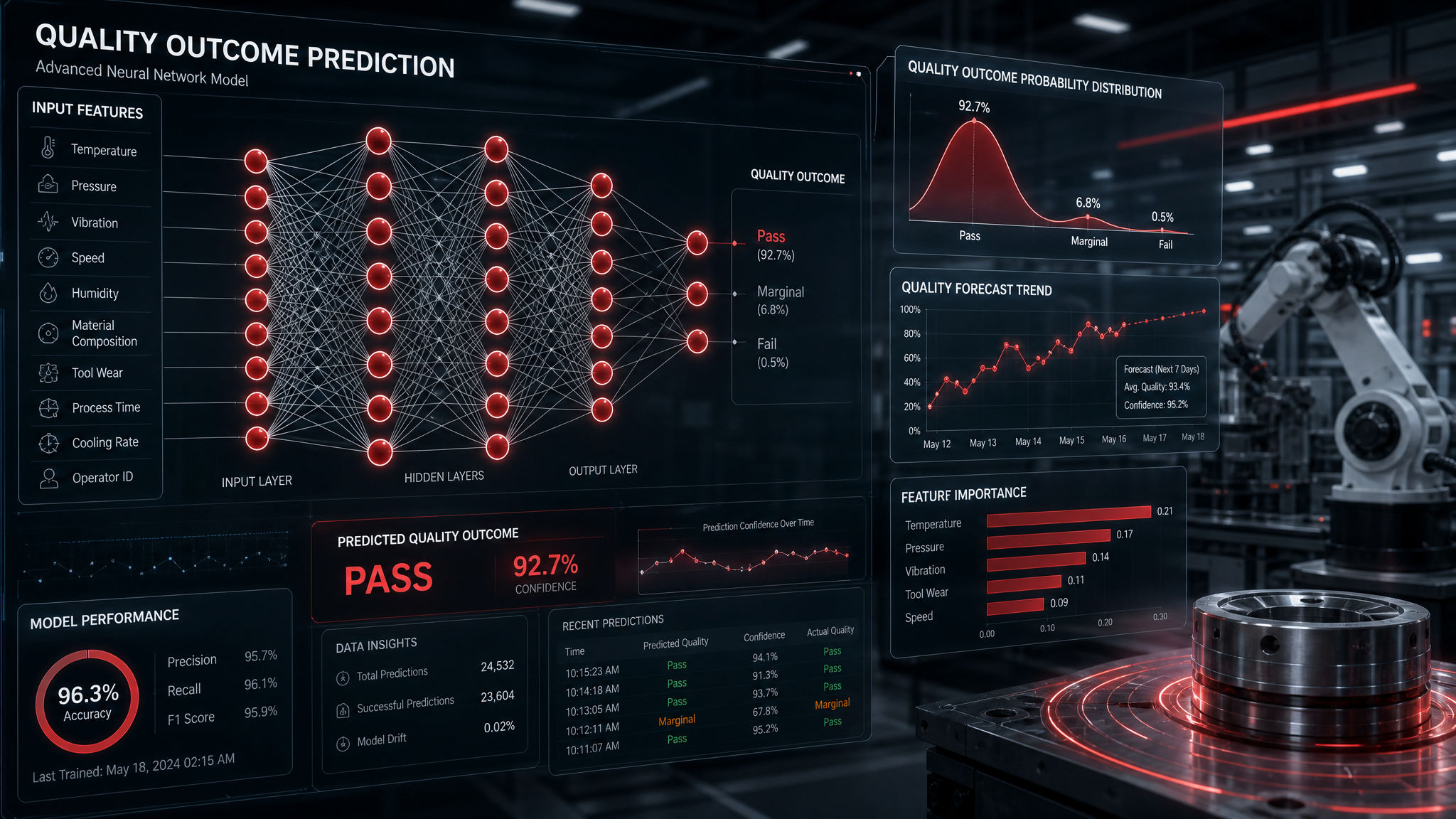
A predictive model that lives in a data scientist's notebook delivers zero value. Deploy models as APIs or edge services that integrate with your MES and QMS. Create operator-friendly dashboards that show predictions in context — "Current process conditions predict 92% probability of parts meeting spec. Confidence: High." Monitor model performance continuously. Concept drift — where the relationship between inputs and outputs changes over time — is the silent killer of production ML models. Retrain on a scheduled basis and when performance metrics degrade.
Frequently Asked Questions
What is predictive quality analytics in manufacturing?
What machine learning algorithms are most effective for quality prediction?
How do I build a predictive quality model for my manufacturing process?
About the Author
John Lee
Founder & Quality Systems Architect
John Lee brings over 20 years of hands-on experience in quality management across automotive, aerospace, and medical device manufacturing. As the founder of IntelligentQMS, he has helped organizations worldwide implement robust quality management systems that drive operational excellence.
Related Articles
AI-Powered Quality Inspection: Computer Vision and Machine Learning on the Shop Floor
Real-Time SPC in the Age of Quality 4.0: From Manual Charts to Automated Process Control