AI-Powered Quality Inspection: Computer Vision and Machine Learning on the Shop Floor
Discover how manufacturers are using computer vision and machine learning to automate visual inspection — achieving higher accuracy, faster throughput, and 24/7 consistency.
John Lee
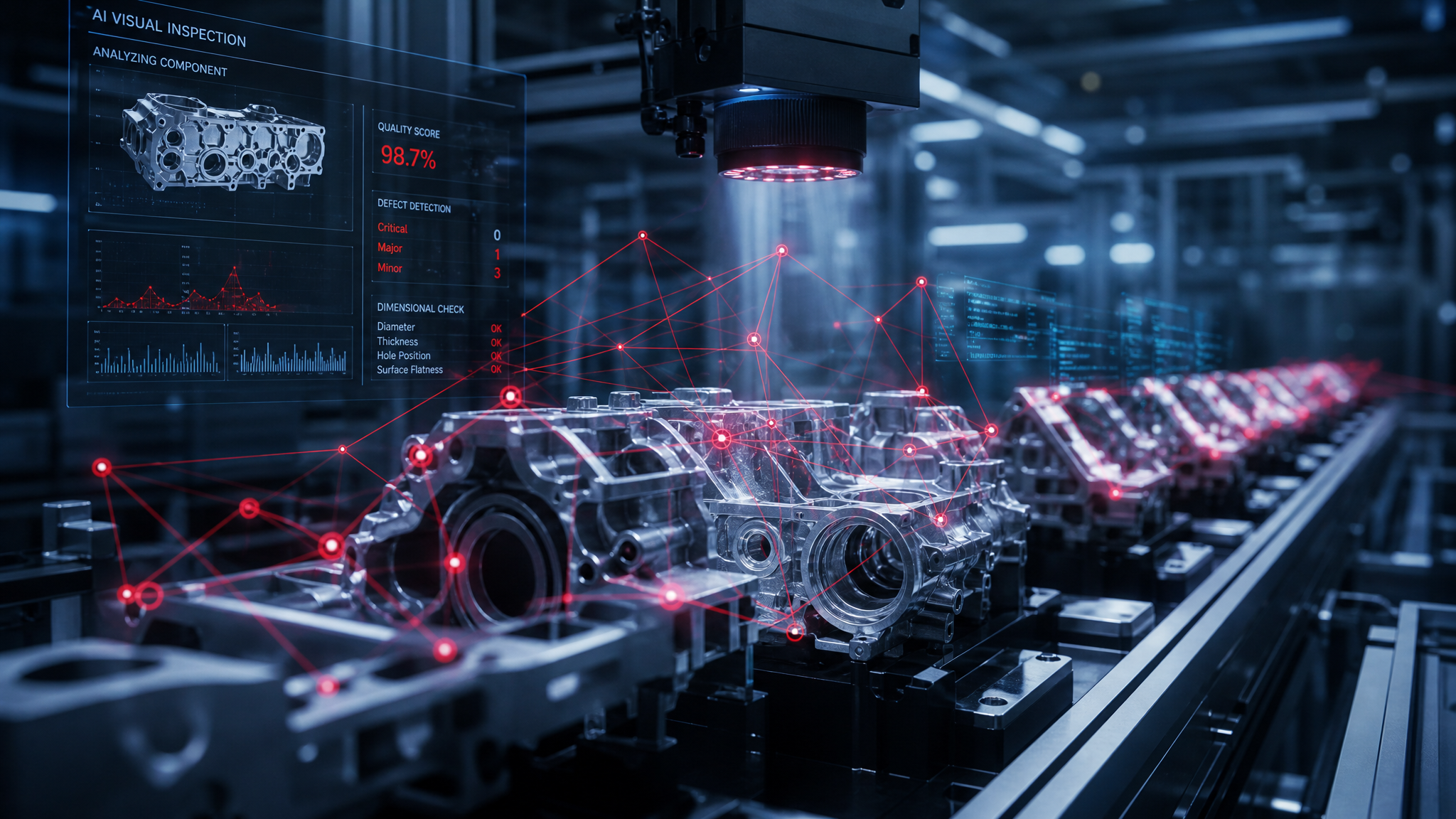
Illustrative image generated using AI; any people depicted are not real individuals.
Visual inspection is one of the most impactful applications of artificial intelligence in manufacturing quality. Where human inspectors face fatigue, inconsistency, and throughput limitations, AI-powered computer vision systems deliver tireless, consistent, and often more accurate defect detection at production line speeds.
How Computer Vision Inspection Works
AI visual inspection systems combine industrial cameras (2D, 3D, or hyperspectral), edge computing hardware, and deep learning algorithms. Here is the typical architecture:
- Image Acquisition: High-resolution cameras capture images of every part at production speed. Lighting is carefully controlled to maximize defect visibility — ring lights for surface defects, backlighting for dimensional checks, and structured light for 3D surface analysis.
- Preprocessing: Raw images are normalized, cropped, and enhanced. Region-of-interest (ROI) extraction focuses the AI model on relevant areas of the part.
- AI Inference: Convolutional neural networks (CNNs) — typically architectures like ResNet, EfficientNet, or custom U-Net models — classify each image as pass/fail or identify specific defect types and locations.
- Decision and Action: Results are communicated in milliseconds. Reject signals trigger automated sorting mechanisms, and defect data flows directly into the QMS for trend analysis and corrective action.
Real-World Performance Data
The performance improvement from AI inspection is well-documented across industries:
- Automotive: A Tier 1 supplier implementing AI vision for stamped metal parts achieved 99.2% defect detection rate versus 82% with manual inspection — a study published in the Journal of Manufacturing Systems (2024).
- Electronics: PCB manufacturers using AI inspection report 98.5% detection of solder defects with cycle times under 2 seconds per board, compared to 15–30 seconds for manual inspection (IPC benchmark data, 2024).
- Medical Devices: AI-powered inspection of injection-molded components achieved 99.7% accuracy for critical dimensional checks, meeting FDA 21 CFR Part 820 validation requirements (Fraunhofer IPT study, 2023).
Implementation Approach: Five Steps
Step 1: Define the Inspection Challenge
Not every inspection task is suitable for AI. The best candidates are high-volume, repetitive inspections where human performance is inconsistent. Cosmetic surface defects, dimensional verification, presence/absence checks, and label verification are proven use cases.
Step 2: Collect and Label Training Data
Capture a representative dataset of both good parts and defective parts. Label each defect type clearly. Data quality matters more than quantity — 300 well-labeled images per defect type outperforms 3,000 inconsistently labeled ones.
Step 3: Select and Train the Model
For classification (pass/fail), start with pre-trained models and fine-tune. For localization (where is the defect?), use object detection models like YOLO or segmentation models like U-Net. Modern AutoML platforms can accelerate this process significantly.
Step 4: Validate and Deploy
Validate the model against a held-out test dataset that the model has never seen. For safety-critical applications, conduct Gage R&R studies comparing AI performance to your measurement system requirements. Deploy on edge computing hardware positioned at the inspection station.
Step 5: Monitor and Retrain
AI models can drift over time as products, materials, or processes change. Implement monitoring dashboards that track detection rates, false positives, and false negatives. Schedule periodic retraining with new data to maintain peak performance.
Integrating AI Inspection with Your QMS
The full value of AI inspection is realized when inspection data flows directly into your quality management system. Defect trends feed FMEA risk reassessments, SPC charts update automatically, and corrective action workflows trigger when defect rates exceed thresholds. This closed-loop integration is the hallmark of Quality 4.0.
Frequently Asked Questions
How accurate is AI-powered visual inspection compared to human inspectors?
How much training data does an AI inspection system need?
What is the ROI of implementing AI visual inspection in manufacturing?
About the Author
John Lee
Founder & Quality Systems Architect
John Lee brings over 20 years of hands-on experience in quality management across automotive, aerospace, and medical device manufacturing. As the founder of IntelligentQMS, he has helped organizations worldwide implement robust quality management systems that drive operational excellence.
Related Articles
Predictive Quality Analytics: Using Machine Learning to Prevent Defects Before They Occur
How AI Is Transforming Quality Inspection in Manufacturing