Blockchain for Quality Traceability: Securing the Quality Record in a Digital World
Explore how blockchain technology creates immutable, tamper-proof quality records that strengthen traceability, regulatory compliance, and customer trust.
John Lee
Illustrative image generated using AI; any people depicted are not real individuals.
In quality management, the integrity of your records is as important as the processes they document. A corrective action report that could have been altered, an inspection record with a questionable timestamp, a certificate of analysis that might be fraudulent — any of these undermines trust in your entire quality system. Blockchain technology provides a solution: an immutable ledger where quality records, once written, cannot be changed without detection.
Blockchain Fundamentals for Quality Professionals
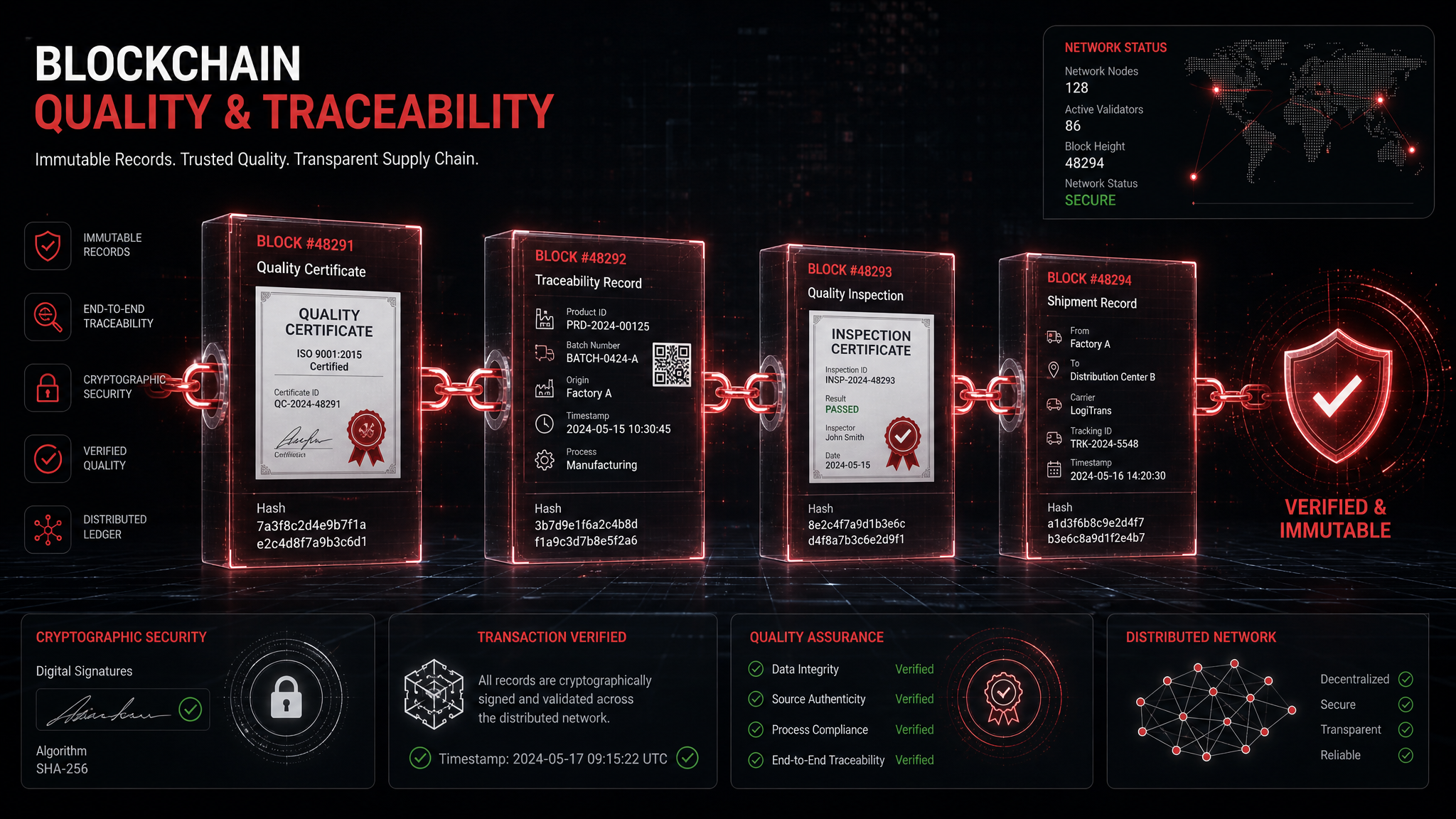
At its core, a blockchain is a distributed ledger where each new record (block) contains a cryptographic hash of the previous record, creating an unbreakable chain. If anyone attempts to alter a historical record, the hash chain breaks — and every participant in the network can detect the tampering.
For quality management, the key properties are:
- Immutability: Records cannot be altered after creation. This directly supports regulatory requirements for data integrity (ALCOA+ principles).
- Transparency: Authorized parties can verify any record without relying on a single central authority.
- Traceability: Every record has a precise timestamp and creation context, creating an unbroken audit trail.
- Decentralization: No single party controls the data, creating trust in multi-party supply chains.
Quality Management Use Cases
Material Certification Verification
Fraudulent material certifications are a real and growing problem. The US Department of Justice has prosecuted multiple cases of falsified material test reports in the aerospace and defense supply chain. Blockchain allows the testing laboratory to write the certification directly to the ledger — the customer can verify its authenticity without relying on the supplier as an intermediary.
Honeywell Aerospace's GoDirect Trade platform uses blockchain to verify the provenance and documentation of aircraft parts. The system has processed over $4 billion in parts transactions with complete traceability (Honeywell, 2024).
Product Recall Traceability
When a recall is necessary, speed and accuracy are critical. Blockchain-based lot traceability enables manufacturers to identify exactly which products, from which material lots, shipped to which customers — in minutes rather than days. Walmart's blockchain pilot for food traceability reduced the time to trace a food item's origin from 7 days to 2.2 seconds (Harvard Business Review, 2023).
Calibration Chain of Custody
For regulated industries, calibration traceability — proving that your measurement instruments were calibrated against traceable standards — is non-negotiable. Blockchain creates an immutable record of every calibration event, the standard used, the results, and the calibrating organization. This chain of custody is verifiable by any auditor without relying on paper certificates that could be forged or lost.
Implementation: Practical Approaches
Enterprise blockchain for quality management is not the same as cryptocurrency. You do not need a public blockchain, energy-intensive mining, or cryptocurrency tokens. Private or consortium blockchain networks — where participants are known and permissioned — provide the data integrity benefits without the complexity and energy costs of public chains.
Implementation options range from full blockchain platforms (Hyperledger Fabric, R3 Corda) to blockchain-as-a-service (Amazon Managed Blockchain, Azure Blockchain Service) to lightweight approaches where quality records are hashed and anchored to a public blockchain for verification without storing sensitive data on-chain.
For most manufacturers, the lightweight approach — hash anchoring — provides 90% of the data integrity benefit at 10% of the implementation cost. Your QMS stores the actual records, and a hash of each record is written to the blockchain. If anyone questions whether a record was altered, the hash comparison provides cryptographic proof.
Current Adoption and Outlook
According to a 2024 Gartner survey, 18% of large manufacturers are actively using blockchain for quality or supply chain traceability, with another 35% conducting pilots. The technology is most mature in pharmaceutical (serialization requirements), food and beverage (safety traceability), and aerospace (parts provenance). As the EU Digital Product Passport regulation takes effect in 2027, blockchain adoption for quality traceability is expected to accelerate significantly across all manufacturing sectors.
Frequently Asked Questions
Why is blockchain useful for quality traceability?
What types of quality records benefit most from blockchain?
Is blockchain practical for small and mid-size manufacturers?
About the Author
John Lee
Founder & Quality Systems Architect
John Lee brings over 20 years of hands-on experience in quality management across automotive, aerospace, and medical device manufacturing. As the founder of IntelligentQMS, he has helped organizations worldwide implement robust quality management systems that drive operational excellence.
Related Articles
Quality 4.0 and the Connected Supply Chain: Real-Time Supplier Quality Visibility
Cloud-Based QMS: Why Quality 4.0 Demands Modern Quality Management Software