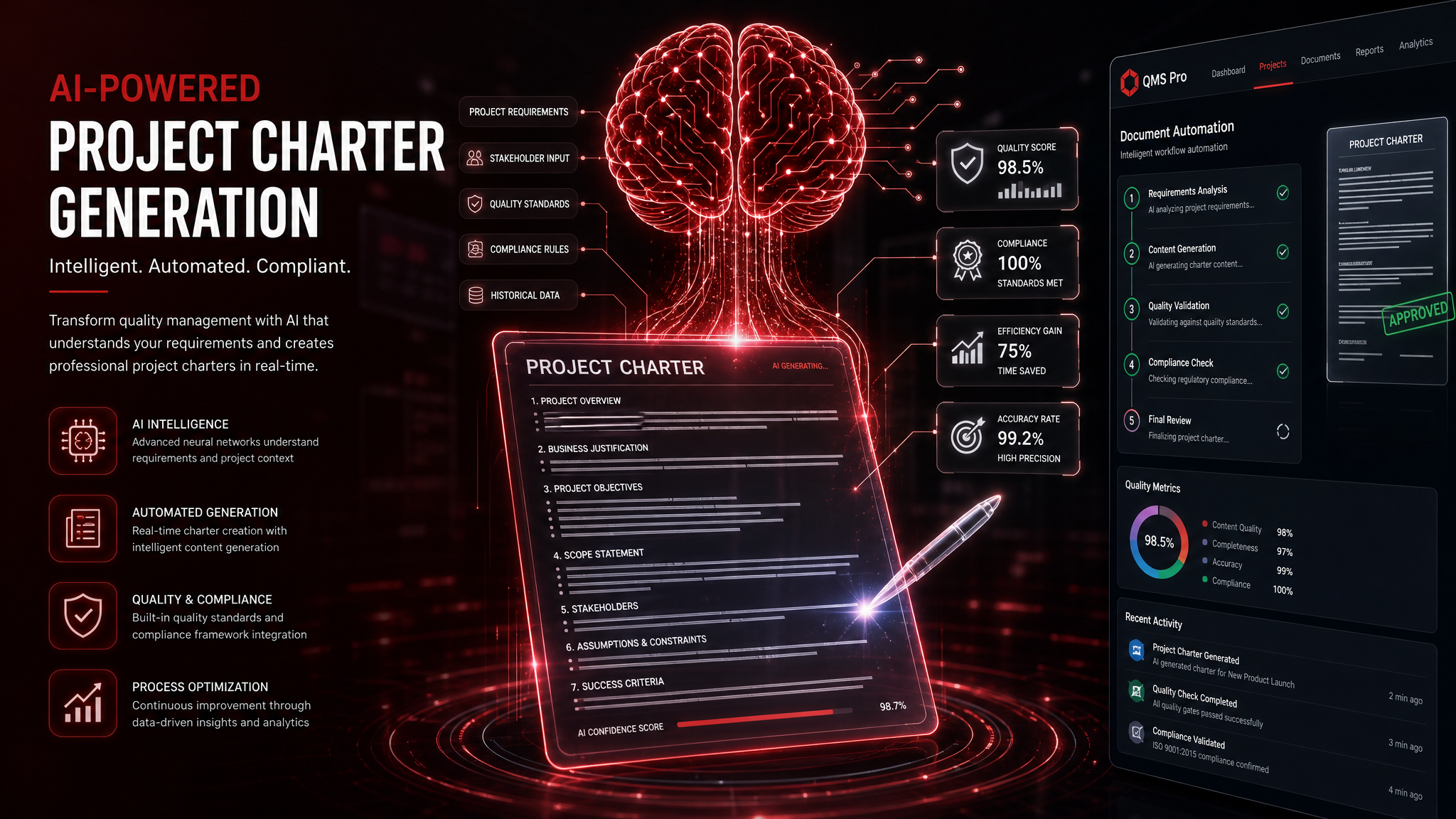
Project Charters in Quality Management: The Complete Guide for Quality Professionals
Everything quality professionals need to know about project charters — why they matter, what to include, common pitfalls to avoid, and how to write charters that get approved and keep improvement projects on track.
John Lee
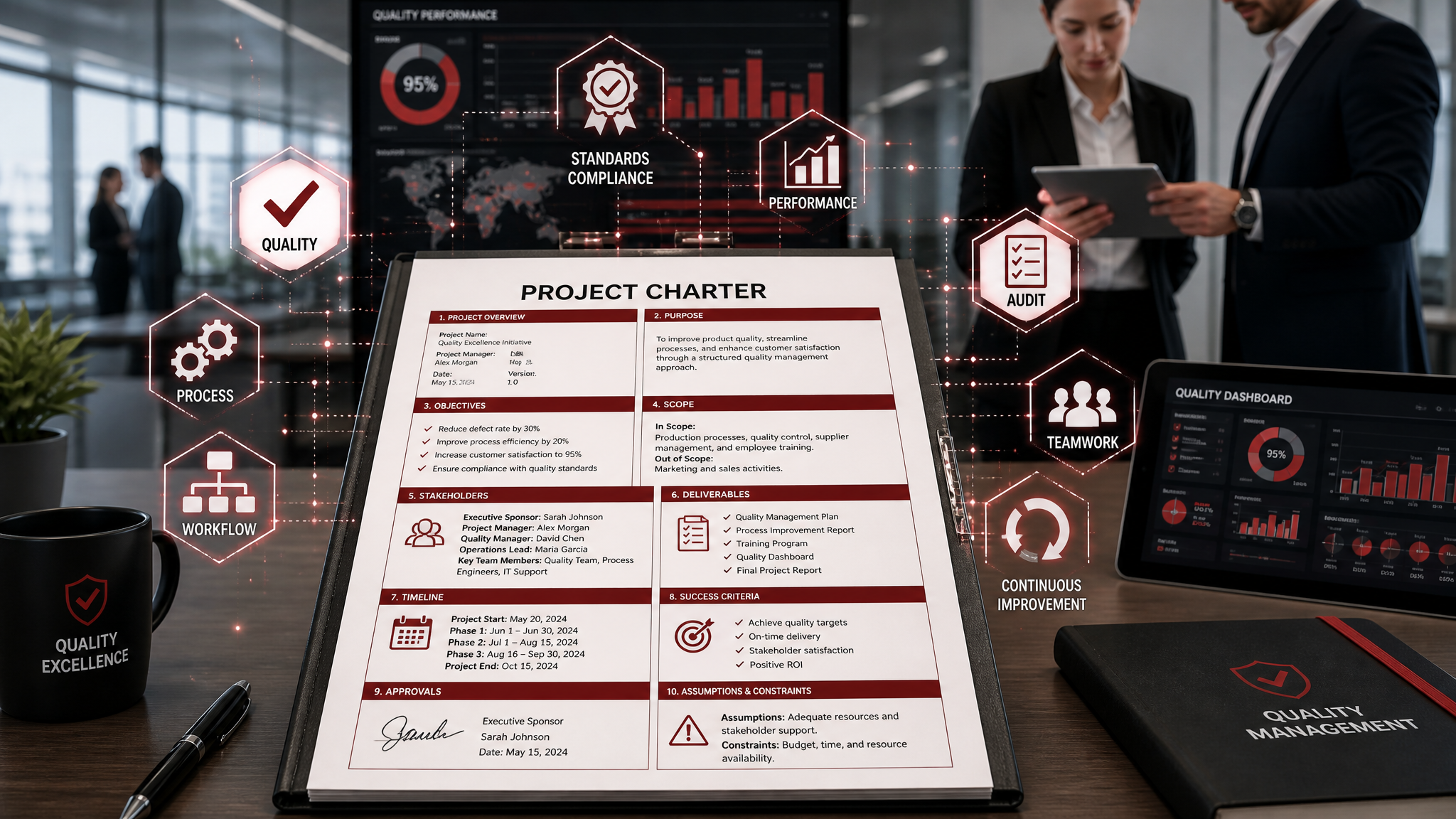
Illustrative image generated using AI; any people depicted are not real individuals.
In over 20 years of leading quality improvement initiatives across automotive, aerospace, and medical device manufacturing, I have seen one pattern repeat itself: the projects that succeed almost always have a strong charter, and the ones that fail almost always do not. A project charter is not paperwork — it is the contract between the team and the organization that defines what will be accomplished, why it matters, and how success will be measured.
Why Project Charters Matter in Quality Management
Quality improvement is not optional work — it competes for the same resources as production, maintenance, and new product launches. Without a formal charter, quality projects suffer from three predictable failures:
- Scope creep: Without defined boundaries, a project to reduce scrap on one press line expands to cover the entire plant, diluting focus until nothing gets done.
- Resource starvation: Without management authorization documented in a charter, team members get pulled back to "real work" whenever production pressure increases.
- Measurement ambiguity: Without agreed-upon metrics, there is no way to objectively determine whether the project succeeded or failed.
Research from the American Society for Quality (ASQ) confirms that organizations with formal project selection and chartering processes achieve 30 to 40 percent higher project completion rates than those relying on informal approaches.
The Two Main Types of Quality Project Charters
Quality professionals typically work with two charter formats, each suited to different types of initiatives:
1. The DMAIC Charter (Easy/Streamlined)
The DMAIC charter is the workhorse of Six Sigma and continuous improvement programs. It is typically a single page that captures the essential information needed to launch and guide a Define-Measure-Analyze-Improve-Control project. This format emphasizes brevity and clarity — if you cannot articulate the project on one page, you probably do not understand it well enough.
Key sections include the problem statement, objective statement, scope, business case, team members, timeline, and preliminary metrics. The DMAIC charter is approved by the project champion (usually a director or VP) and serves as the reference document throughout the project lifecycle.
2. The APQP Charter (Controlled/Comprehensive)
The APQP (Advanced Product Quality Planning) charter is used for new product launches, major process changes, and projects in highly regulated industries. It is a multi-page controlled document that includes full team rosters with roles and responsibilities, stakeholder matrices, detailed requirement breakdowns, phase-gate milestone plans, risk assessments, and formal approval workflows.
This format is standard in automotive (IATF 16949), aerospace (AS9100), and medical device (ISO 13485) environments where regulatory traceability and documented evidence of planning are mandatory.
Writing a Problem Statement That Gets Approval
The problem statement is the single most important element of any charter. It must answer three questions: What is wrong? How big is the problem? What is the impact?
A weak problem statement reads: "We have too many defects." A strong one reads: "Line 3 scrap rate has increased from 2.1% to 4.8% over the past six months, resulting in $340K in annual material waste and contributing to three customer complaints (8D-2026-041, 042, 047)."
The difference is specificity. Quantify the gap, attach a financial impact, and reference actual data. This is what transforms a charter from a wish list into a business case that management will fund.
Defining SMART Objectives
Every charter objective should follow the SMART framework:
- Specific: Reduce Line 3 scrap rate
- Measurable: From 4.8% to below 2.0%
- Achievable: Historical performance shows 1.8% was sustained in 2024
- Relevant: Directly supports plant cost reduction target and customer satisfaction goals
- Time-bound: By December 31, 2026
Avoid vague objectives like "improve quality" or "reduce waste." If you cannot measure it, you cannot charter it.
Team Structure and Roles
A quality project charter should clearly define:
- Champion/Sponsor: The senior leader who authorizes resources and removes barriers. This person does not do the work but ensures the team can.
- Project Leader: The person accountable for day-to-day execution. In Six Sigma, this is typically a Green Belt or Black Belt.
- Core Team: The 4 to 6 people who attend every meeting and do the analytical work. Cross-functional representation is critical — include operations, engineering, quality, and maintenance.
- Extended Team/SMEs: Subject matter experts who contribute as needed but are not full-time members.
Scope Management: The Art of Saying No
Scope boundaries are where most charters fail. The "In Scope" section defines what the project will address. Equally important is the "Out of Scope" section, which explicitly states what will NOT be addressed. This prevents the project from expanding beyond its ability to deliver results.
A useful test: if the scope section does not make at least one stakeholder slightly uncomfortable about what was excluded, it is probably too broad.
Common Charter Pitfalls
- Solution-first thinking: The charter should define the problem, not prescribe the solution. If you already know the answer, you do not need a project.
- Missing baseline data: A charter without current performance data is just an opinion. Collect baseline measurements before finalizing the charter.
- Too many metrics: Focus on one or two primary metrics (Y variables). Secondary metrics can be tracked but should not dilute focus.
- No financial linkage: Every quality project should quantify the expected financial benefit. If you cannot connect the improvement to dollars, reconsider whether it deserves dedicated resources.
- Unengaged champion: A charter signed by a champion who never reviews progress is worse than no charter at all. Ensure your champion is genuinely invested in the outcome.
The Charter as a Living Document
A charter is not a set-and-forget document. It should be revisited at each phase gate — especially after the Measure and Analyze phases in DMAIC — to confirm that the original problem statement and objectives are still valid given what the data has revealed. If the data shows a fundamentally different problem than what was chartered, have the courage to revise the charter or, if necessary, close the project and open a new one.
Moving Forward
Whether you are a quality engineer writing your first charter or a Black Belt leading your twentieth project, the principles remain the same: be specific about the problem, be clear about the scope, be honest about the resources, and be rigorous about the metrics. A strong charter does not guarantee success, but it dramatically increases your odds — and that is what quality management is all about.
Frequently Asked Questions
What is a project charter in quality management and why is it important?
What are the essential elements every quality project charter should include?
How long should a quality project charter be?
About the Author
John Lee
Founder & Quality Systems Architect
John Lee brings over 20 years of hands-on experience in quality management across automotive, aerospace, and medical device manufacturing. As the founder of IntelligentQMS, he has helped organizations worldwide implement robust quality management systems that drive operational excellence.
Related Articles
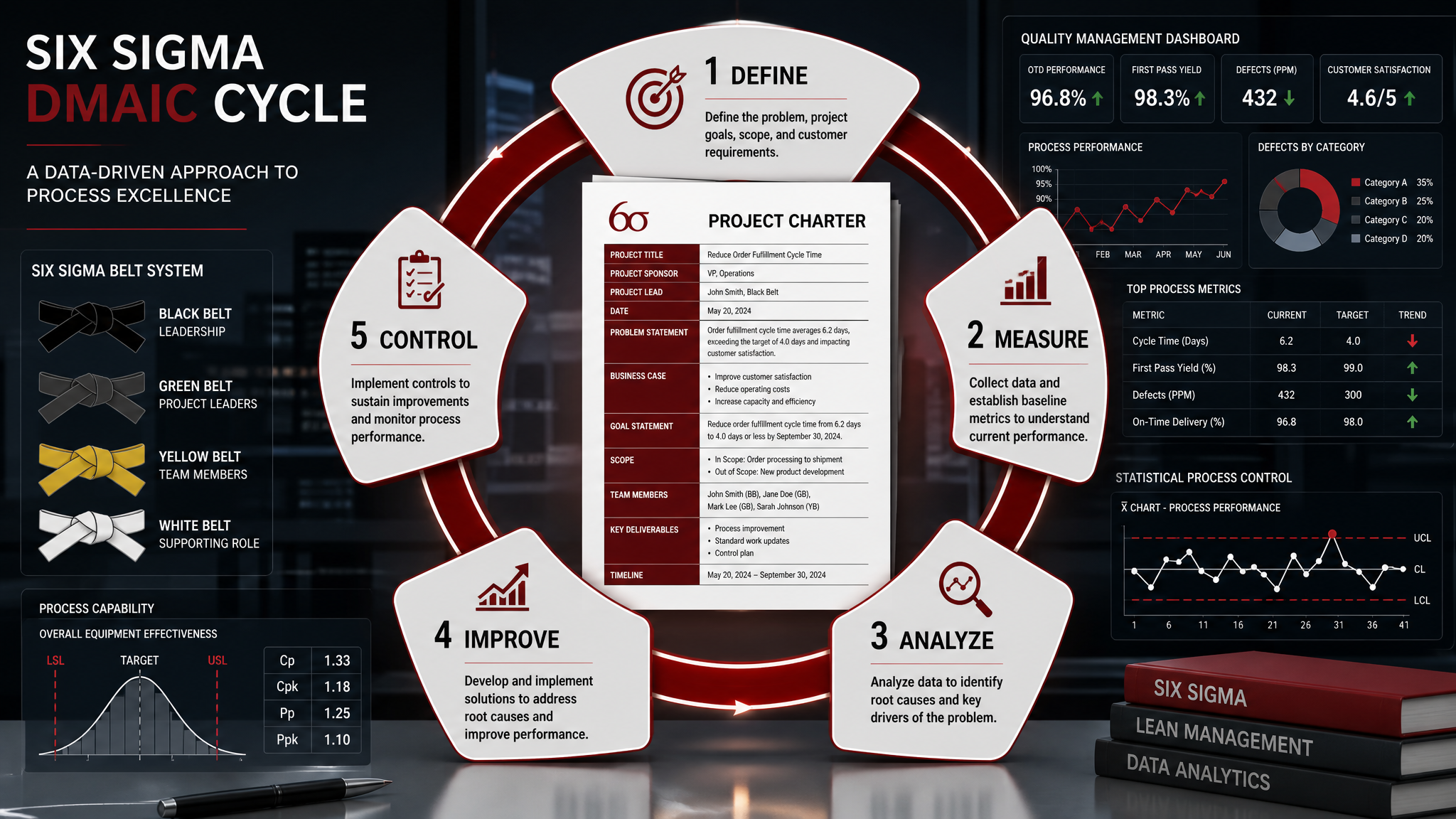
DMAIC Project Charter Template: How to Write a One-Page Six Sigma Charter That Gets Results
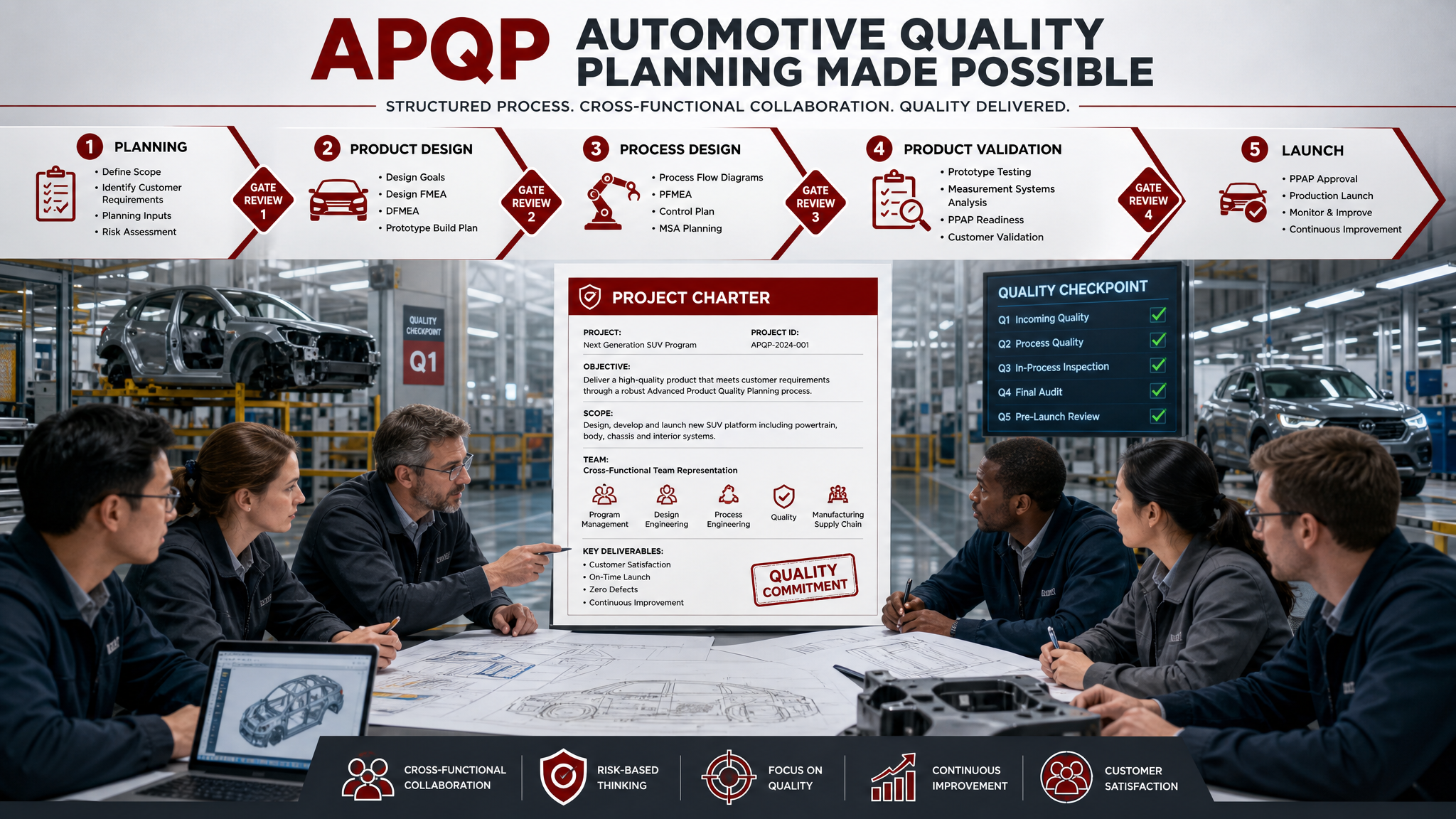
APQP Project Charter: How to Create a Controlled Charter Document for Automotive and Regulated Industries