DMAIC Project Charter Template: How to Write a One-Page Six Sigma Charter That Gets Results
A practical, field-tested guide to creating effective DMAIC project charters — with a downloadable template structure, real-world examples, and the exact format used by certified Black Belts.
John Lee
Illustrative image generated using AI; any people depicted are not real individuals.
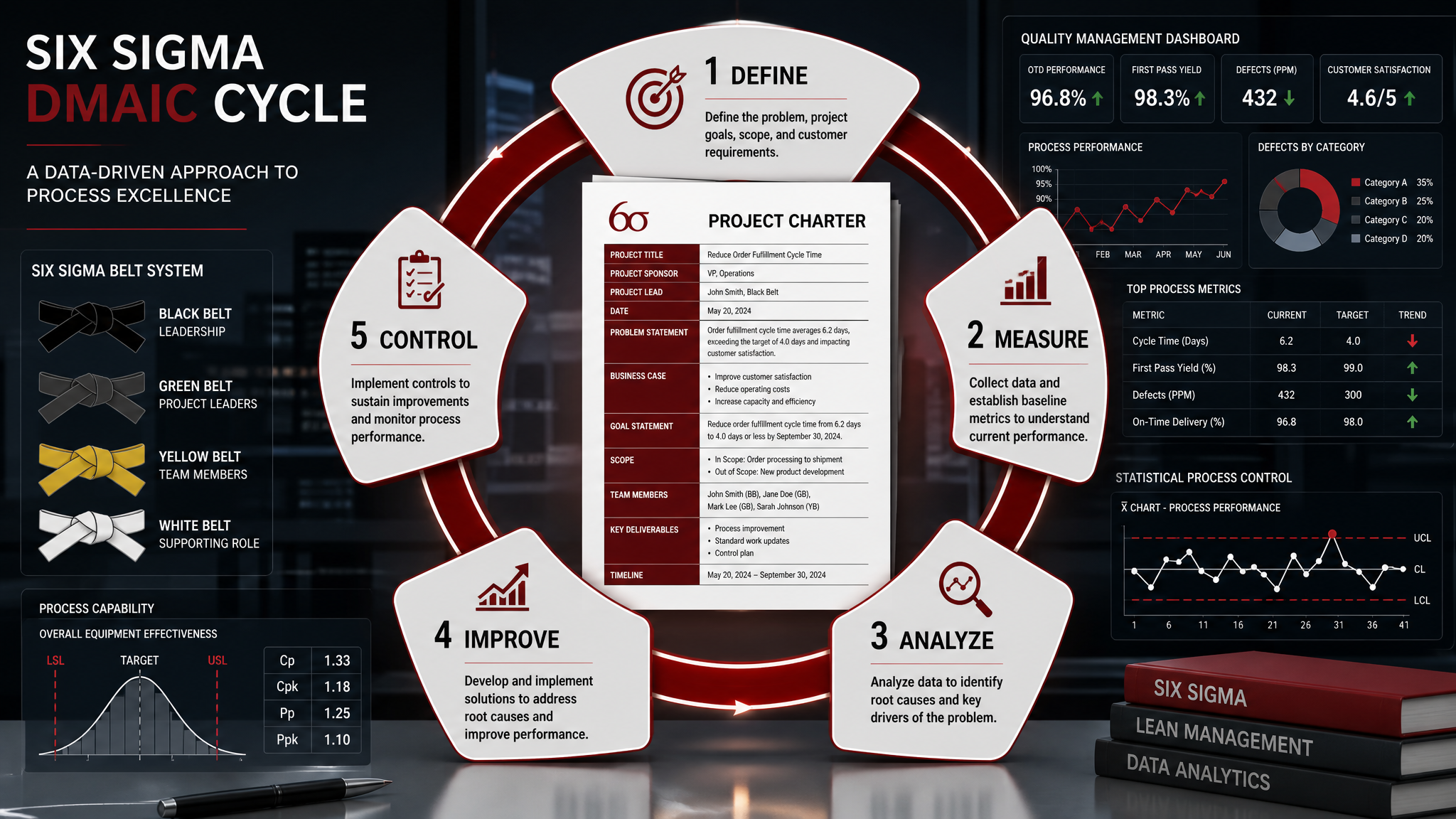
The DMAIC project charter is the foundational document of every Six Sigma improvement project. It is completed during the Define phase and serves as the project's north star from kickoff through Control. In my experience leading and coaching over 200 Six Sigma projects, I have found that the quality of the charter directly predicts the quality of the outcome. A tight, well-researched charter leads to a focused project. A vague or bloated charter leads to months of wasted effort.
The One-Page Rule
A DMAIC charter should fit on a single page. This is not arbitrary — it is a discipline. If you need more than one page to describe the problem, scope, and team, the project is either too broad or you do not understand it well enough yet. The constraint forces precision in language and thinking.
The Japanese concept of A3 thinking, which Toyota made famous, follows the same principle: force all the relevant information onto a single sheet so that anyone can understand the project at a glance. Your charter should pass the "elevator test" — a colleague should be able to read it in two minutes and understand exactly what you are doing and why.
Section-by-Section Breakdown
Project Title and ID
The title should be action-oriented and specific. "Reduce Assembly Line 2 First-Pass Yield Losses" is better than "Quality Improvement Project." Include a unique project ID for tracking in your project portfolio system.
Problem Statement
This is the most critical section. A strong problem statement follows the formula: What is happening + how big is the gap + what is the impact. Never include causes or solutions in the problem statement — that is what the Analyze phase is for.
Bad: "Operators are not following work instructions, causing defects on Line 2."
Good: "First-pass yield on Assembly Line 2 has declined from 97.2% to 93.8% since January 2026, resulting in approximately $18,000/month in rework labor and contributing to two customer quality escapes (8D-2026-015, 8D-2026-022)."
Objective Statement
State what the project will achieve using SMART criteria. Example: "Restore Assembly Line 2 first-pass yield to ≥97.0% and sustain for 90 consecutive days by November 30, 2026." The objective should be ambitious but achievable based on historical performance data.
Business Case
Translate the improvement into financial terms. "Achieving the target yield will eliminate approximately $216,000 in annual rework costs and reduce customer complaint risk, supporting our plant-level cost reduction target of $1.2M." Champions approve resources based on business impact, not technical interest.
Project Scope
Define clear boundaries with explicit in-scope and out-of-scope statements:
- In scope: Assembly Line 2, all three shifts, product families A through D
- Out of scope: Upstream machining operations, raw material quality (covered by separate supplier initiative), Assembly Lines 1 and 3
Team Structure
List each team member with their role, department, and expected time commitment. A typical DMAIC team includes 4 to 6 core members plus a champion. Over-staffing a project is as dangerous as under-staffing — too many voices slow decision-making.
Timeline and Milestones
Map each DMAIC phase to a target completion date. A typical timeline for a well-scoped project is 4 to 6 months total:
- Define: 2 weeks (charter approval)
- Measure: 3 to 4 weeks (data collection plan, baseline capability)
- Analyze: 3 to 4 weeks (root cause identification and verification)
- Improve: 4 to 6 weeks (solution development, pilot, implementation)
- Control: 4 weeks (control plan, process monitoring, handoff)
Preliminary Metrics
Identify the primary metric (Y) and any secondary metrics. For the example above:
- Primary Y: First-pass yield (%)
- Secondary: Rework cost ($/month), customer complaints (count)
Charter Review Checklist
Before submitting for champion approval, validate your charter against these criteria:
- Problem statement uses data, not opinions or assumed causes
- Objective is measurable with a specific target and deadline
- Scope is narrow enough to complete in 4 to 6 months
- Business case includes a dollar figure or quantified operational impact
- Team includes cross-functional representation (not just quality)
- Champion is identified and has agreed to sponsor the project
Living Document: When to Revise the Charter
The charter may need revision after the Measure phase if baseline data reveals a different problem than originally assumed, or after the Analyze phase if root causes point to a scope that needs adjustment. Any revision should go back to the champion for re-approval. This is not failure — it is intellectual honesty.
From Charter to Results
The DMAIC charter is not a bureaucratic hurdle — it is a thinking tool. The discipline of articulating a clear problem, defining measurable objectives, and establishing team accountability in a single page sets the stage for everything that follows. Master the charter, and you master the Define phase. Master the Define phase, and you dramatically increase your odds of project success.
Frequently Asked Questions
What sections should a DMAIC project charter include?
When should the DMAIC charter be written and who approves it?
What makes a DMAIC problem statement effective?
About the Author
John Lee
Founder & Quality Systems Architect
John Lee brings over 20 years of hands-on experience in quality management across automotive, aerospace, and medical device manufacturing. As the founder of IntelligentQMS, he has helped organizations worldwide implement robust quality management systems that drive operational excellence.
Related Articles

Project Charters in Quality Management: The Complete Guide for Quality Professionals
APQP Project Charter: How to Create a Controlled Charter Document for Automotive and Regulated Industries