APQP Project Charter: How to Create a Controlled Charter Document for Automotive and Regulated Industries
A detailed walkthrough of the APQP project charter format — including team matrices, stakeholder management, gate reviews, and regulatory traceability required for IATF 16949 and AS9100 compliance.
John Lee
Illustrative image generated using AI; any people depicted are not real individuals.
When you are launching a new product for an automotive OEM, preparing a production part for an aerospace prime, or introducing a Class II medical device to market, the stakes are too high for a one-page charter. These environments demand a controlled charter document that captures every stakeholder, every requirement, every milestone, and every risk — with full traceability and formal approval workflows. This is the APQP project charter.
Why Regulated Industries Need Controlled Charters
In IATF 16949 (automotive), AS9100 (aerospace), and ISO 13485 (medical device) environments, quality planning documentation is not optional — it is auditable evidence that the organization systematically planned for quality before production began. Auditors will ask to see your project charter, team assignments, timing plan, and risk assessment. If these do not exist as controlled documents with revision history and approval records, you have a finding.
Beyond compliance, controlled charters serve a practical purpose: complex, cross-functional programs with 12-to-24-month timelines need a structured reference document that the entire team can rely on. The APQP charter is that document.
Structure of a Controlled APQP Charter
Cover Page
The cover page establishes the document as a formal controlled document. It includes the project title, project number, customer name, product/part number, charter revision level, date, and document owner. A distribution list identifies who receives controlled copies.
Project Overview and Business Case
This section captures the strategic rationale: why is this project being undertaken? Include the customer program name, expected annual volume, revenue projection, program start of production (SOP) date, and strategic alignment with company objectives. Unlike a DMAIC charter where the business case centers on cost savings, the APQP business case focuses on revenue, market access, and customer relationship value.
Team Roster and Responsibility Matrix
A detailed team matrix lists every team member with their name, department, role, phone, email, and specific responsibilities mapped to APQP phases. A RACI matrix (Responsible, Accountable, Consulted, Informed) for major deliverables ensures clarity about who does what. For large programs, this may include representatives from engineering, quality, manufacturing, purchasing, logistics, sales, and the customer's quality representative.
Stakeholder Matrix
Beyond the core team, a stakeholder matrix identifies everyone who has an interest in the project outcome — senior management, customer contacts, regulatory bodies, sister plants, and key suppliers. Each stakeholder is classified by their level of influence and interest, with a communication plan defining how and when they will be updated.
Customer and Regulatory Requirements
This section is unique to APQP charters. It captures:
- Customer-specific requirements (CSRs) from the OEM
- Applicable industry standards (IATF 16949, AS9100, ISO 13485)
- Regulatory requirements (REACH, RoHS, FMVSS, FAA, FDA)
- Special characteristics identified by the customer or internal team
- Material and substance compliance requirements
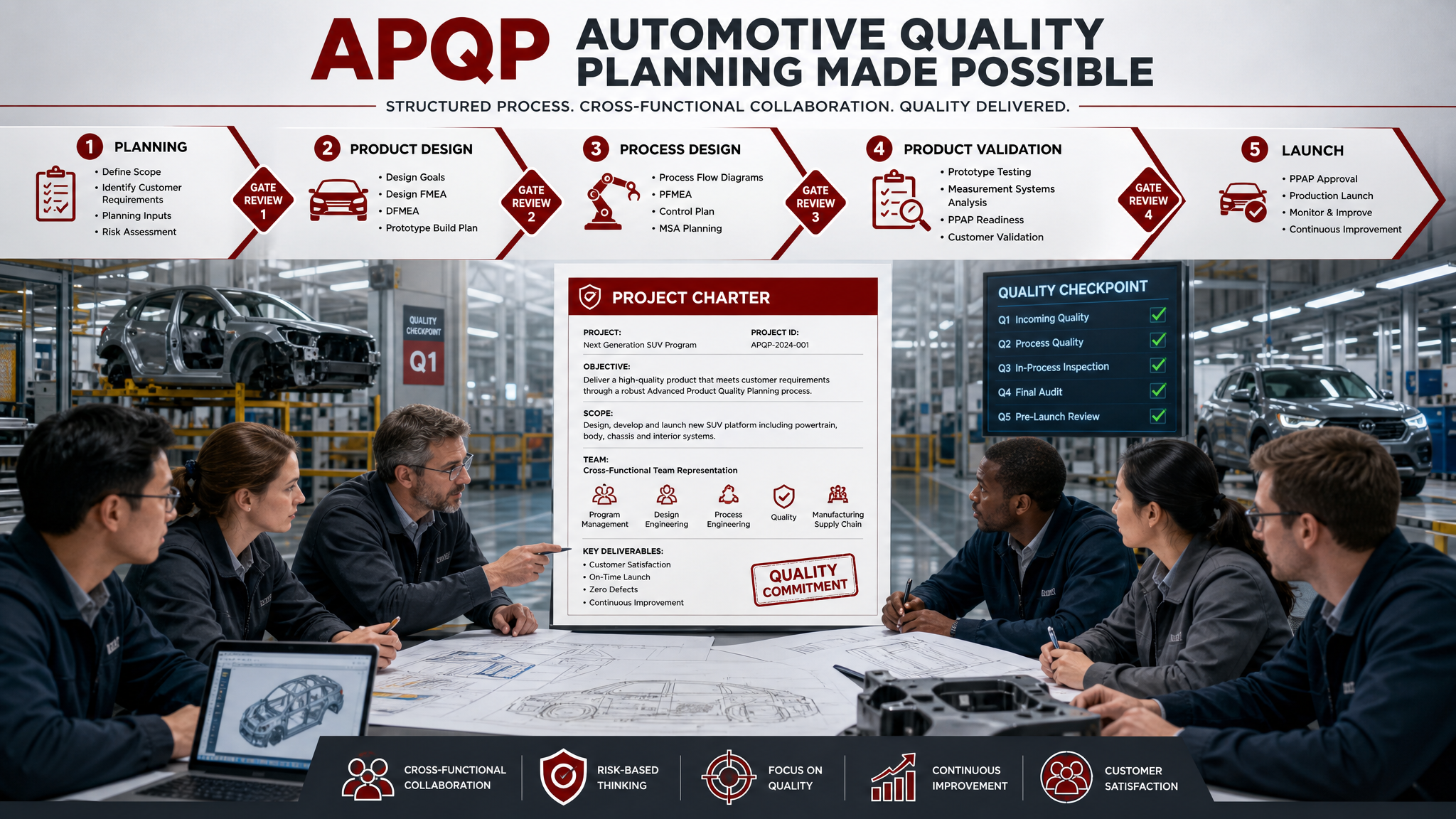
Phase-Gate Timeline
The APQP timeline is organized by phase gate:
- Gate 1 — Program Approval: Charter signed, team formed, preliminary feasibility completed
- Gate 2 — Design Approval: DFMEA complete, prototype validated, design review closed
- Gate 3 — Process Readiness: PFMEA complete, control plan approved, tooling ordered
- Gate 4 — Validation Complete: Production trial run successful, PPAP submitted and approved
- Gate 5 — Launch Review: Initial production monitored, lessons learned captured, charter closed
Each gate has defined entry and exit criteria. The charter documents these criteria so the team knows exactly what must be completed before advancing.
Risk Assessment
A preliminary risk assessment identifies the top program risks at charter creation. This is not a full FMEA — it is a high-level risk register covering technical risks (new material, tight tolerances), supply chain risks (single-source components, long lead-time tooling), timing risks (compressed timeline, resource conflicts), and commercial risks (volume uncertainty, engineering change frequency).
Resource Plan
The resource plan identifies the capital expenditures (tooling, equipment, gauging), operating expenses (travel, testing, prototype builds), and human resource requirements (dedicated vs. shared team members, contractor needs). This section is critical for securing management approval — it answers the question "what will this cost us?"
Approval Signatures
The charter concludes with formal approval signatures from the project leader, quality manager, engineering manager, operations manager, and executive sponsor. In some organizations, customer quality representative sign-off is also required. Digital signatures with timestamps provide audit-ready evidence of authorization.
Document Control Best Practices
As a controlled document, the APQP charter must follow your organization's document control procedures:
- Assign a unique document number following your numbering convention
- Track revisions with a revision history table showing what changed, who changed it, when, and why
- Maintain the master copy in your document management system
- Ensure obsolete revisions are marked and archived
- Review and re-approve at each phase gate
Common Mistakes in APQP Charters
- Copy-paste from the last program: Every program is different. Reusing a charter without tailoring the risk assessment, team structure, and requirements to the current program creates blind spots.
- Incomplete customer requirements: If you miss a CSR at the charter stage, you will discover it at PPAP submission — when it is too late and expensive to address.
- Unrealistic timelines: Compressing APQP phases to meet an aggressive SOP date without additional resources is a recipe for a failed launch. The charter should reflect reality, not wishful thinking.
- Missing supplier integration: If your tier-2 suppliers are not identified in the charter, their APQP timing will not align with yours.
The Charter as Audit Evidence
During IATF 16949 or AS9100 surveillance audits, auditors frequently request evidence of quality planning for recent product launches. A well-maintained APQP charter — with signed approvals, revision history, completed gate reviews, and closed-out risk items — demonstrates that your organization practices systematic quality planning. This is not just compliance — it is competitive advantage.
Frequently Asked Questions
What is an APQP project charter and when is it required?
How does an APQP charter differ from a DMAIC charter?
What are the five APQP phases referenced in the charter timeline?
About the Author
John Lee
Founder & Quality Systems Architect
John Lee brings over 20 years of hands-on experience in quality management across automotive, aerospace, and medical device manufacturing. As the founder of IntelligentQMS, he has helped organizations worldwide implement robust quality management systems that drive operational excellence.
Related Articles
Project Charters in Quality Management: The Complete Guide for Quality Professionals
DMAIC Project Charter Template: How to Write a One-Page Six Sigma Charter That Gets Results