Reliability-Centered Maintenance (RCM): How to Build a Data-Driven Maintenance Strategy That Eliminates Waste and Prevents Failures
A comprehensive guide to RCM methodology — covering functional failure analysis, consequence evaluation, task selection logic, and how AI enhances RCM decision-making for modern manufacturing operations.
John Lee
Illustrative image generated using AI; any people depicted are not real individuals.
The traditional approach to maintenance in most manufacturing plants follows a simple formula: change the oil every 3 months, replace the belts every year, overhaul the gearbox every 5 years. This calendar-based preventive maintenance philosophy was an improvement over pure breakdown maintenance, but it carries a fundamental flaw — it treats every asset the same way regardless of its actual failure behavior, operating context, or the consequences of its failure.
Reliability-Centered Maintenance (RCM) replaces this one-size-fits-all approach with a rigorous, data-driven methodology that asks: what does each asset actually need to remain reliable, and what is the most cost-effective way to provide it?
The Origin and Evolution of RCM
RCM was developed in the late 1960s by the commercial aviation industry, led by a landmark study by F. Stanley Nowlan and Howard Heap at United Airlines. Their research, published as the MSG-3 maintenance steering group document, demonstrated that the prevailing assumption — that all equipment wears out predictably and therefore benefits from scheduled overhaul — was fundamentally wrong for complex systems.
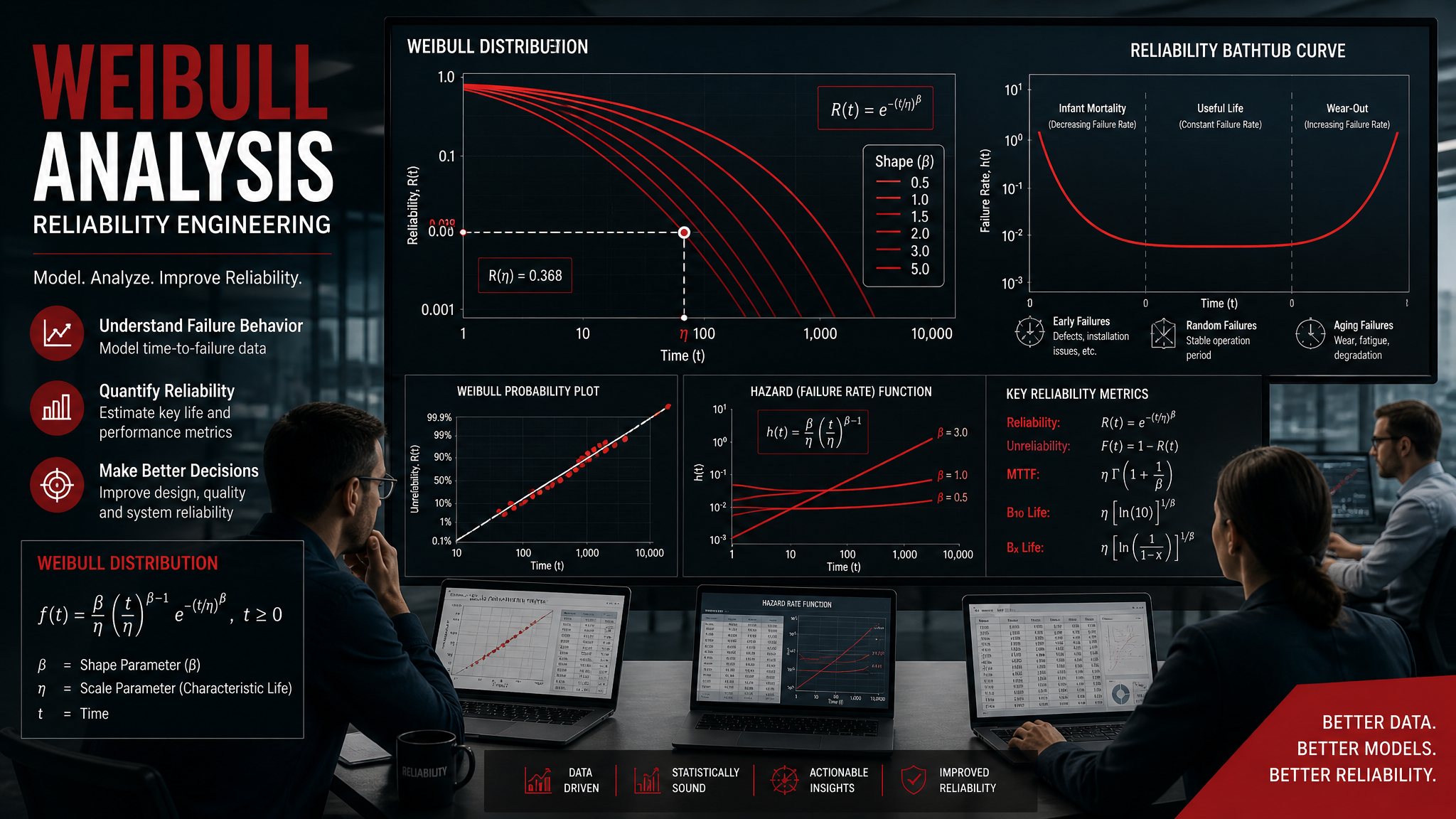
Their analysis of aircraft component failure data revealed a startling finding: only 11% of components exhibited the classic wear-out pattern where failure probability increases with age. The remaining 89% showed constant or decreasing failure rates, meaning scheduled overhaul was either useless or counterproductive for the vast majority of components. This finding revolutionized maintenance philosophy and led to the development of RCM as codified in SAE standard JA1011.
The RCM Decision Logic
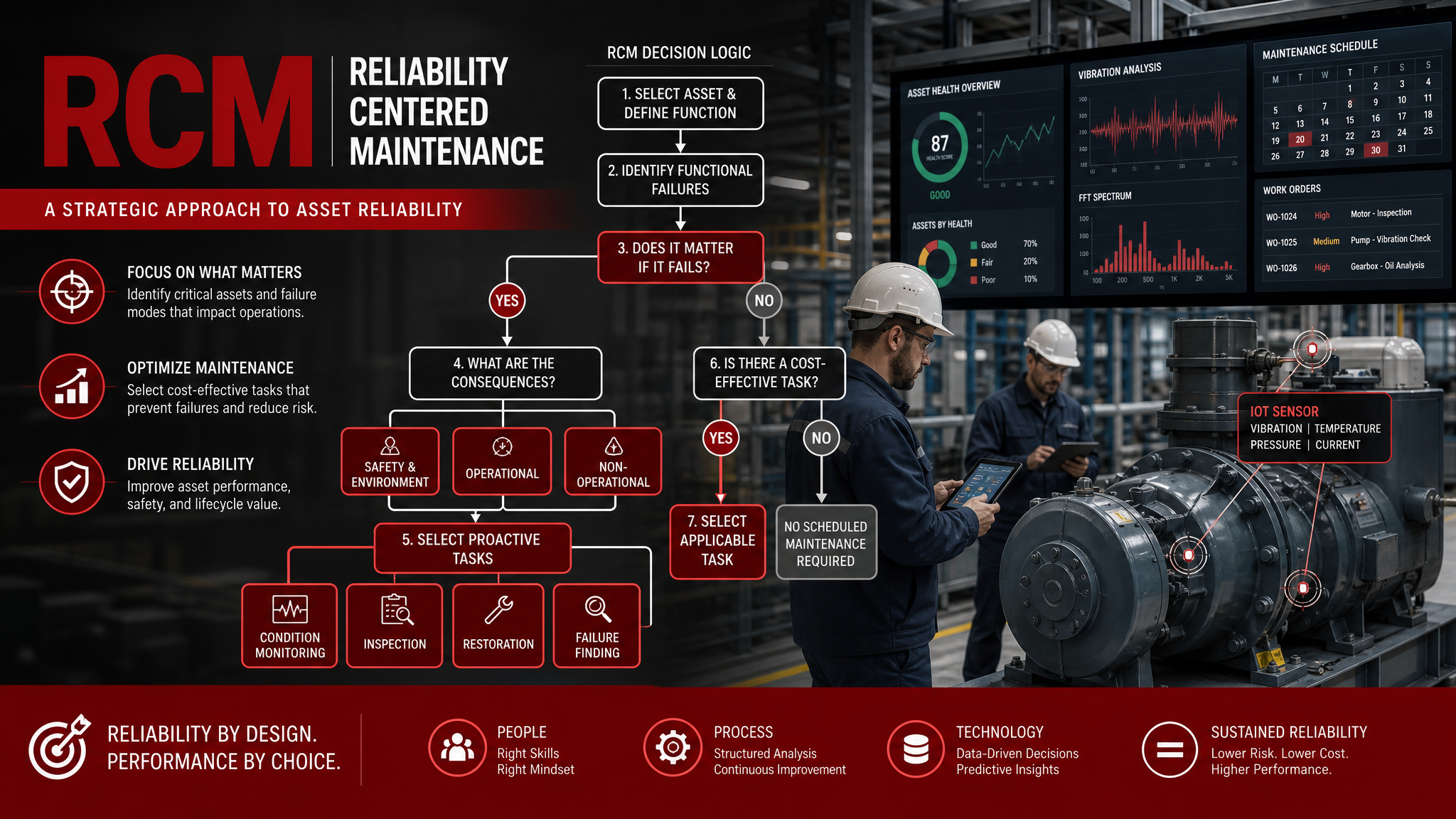
RCM uses a structured decision logic to select the appropriate maintenance task for each failure mode. The process follows the seven questions framework:
Step 1: Define Functions
Every asset exists to perform one or more functions. A pump's primary function might be: "Transfer coolant at 50 GPM and 60 PSI from the reservoir to the machining center." Functions must be defined with performance standards — not just "pump coolant" but "pump coolant at a specific flow rate and pressure." This precision is critical because a functional failure is any deviation below the performance standard, not just a complete stoppage.
Step 2: Identify Functional Failures
For each function, identify the ways the asset can fail to meet its performance standard. Using the pump example:
- Complete loss of flow (pump stops)
- Reduced flow below 50 GPM
- Reduced pressure below 60 PSI
- Coolant contamination (delivering flow but with degraded fluid quality)
Step 3: Identify Failure Modes
For each functional failure, identify the specific failure modes — the physical mechanisms that cause the functional failure. For "complete loss of flow":
- Motor electrical failure
- Impeller shaft fracture
- Coupling failure
- Bearing seizure
- Control system fault (VFD failure)
Step 4: Describe Failure Effects
Document what happens when each failure mode occurs: what does the operator observe? What damage results? How long does it take to repair? What is the production impact? This information drives the consequence classification.
Step 5: Classify Consequences
RCM classifies failure consequences into four categories, in priority order:
- Safety/Environmental: Failure could injure someone or cause environmental harm
- Operational: Failure causes production loss, product quality impact, or customer delivery failure
- Non-operational: Failure requires repair but does not directly impact production (redundant systems, non-critical utilities)
- Hidden: The failure is not evident to the operating crew under normal conditions (protective devices, standby systems)
Step 6: Select Maintenance Tasks
Based on the failure pattern (from Weibull analysis) and the consequence classification, the RCM decision logic selects the appropriate task:
- Condition-Based Maintenance: Applicable when there is a detectable degradation period before failure (P-F interval). The task monitors the condition indicator and triggers maintenance when degradation is detected. Examples: vibration monitoring for bearings, oil analysis for gearboxes, thermal imaging for electrical connections.
- Time-Based Replacement: Applicable ONLY when the failure mode shows a wear-out pattern (β > 1) and a replacement interval can be defined that reduces the failure probability below the acceptable level. If β ≤ 1, time-based replacement does not reduce failures and should not be applied.
- Failure-Finding: Applicable to hidden failure modes (protective devices). The task periodically tests the device to confirm it will function when demanded. Example: monthly function test of a pressure relief valve.
- Run-to-Failure: Applicable when no proactive task is technically feasible or economically justified. The asset runs until it fails, and maintenance is performed reactively. This is a deliberate strategy, not neglect — it is the correct choice when the cost of failure is low and the cost of prevention is high.
Step 7: Default Actions
If no proactive task can adequately manage a safety or environmental consequence, the default action is redesign. The asset must be modified to eliminate the failure mode or mitigate its consequences. For operational consequences, the default may be accepting the risk with a documented justification.
AI-Enhanced RCM Analysis
Traditional RCM analysis is thorough but labor-intensive. A formal RCM study on a single complex asset can take 40 to 80 person-hours. AI is accelerating this process in several ways:
- Automated failure mode identification: AI analyzes FRACAS data and maintenance records to generate preliminary failure mode lists, reducing the time the RCM team spends on brainstorming.
- Data-driven consequence assessment: AI quantifies failure consequences using historical downtime data, repair costs, and production loss records, replacing subjective estimates with evidence-based assessments.
- Optimal interval calculation: For time-based tasks, AI uses Weibull parameters and cost data to calculate the replacement interval that minimizes total cost (preventive replacement cost + risk-weighted failure cost).
- Task effectiveness monitoring: After RCM tasks are implemented, AI monitors whether the expected reliability improvement is materializing, flagging tasks that are not delivering value.
- Risk Priority Number (RPN) calculation: AI assigns severity, occurrence, and detection ratings based on data patterns, generating risk-ranked failure mode lists that focus the team's attention on the highest-priority items.
Common RCM Implementation Mistakes
- Applying RCM to every asset: RCM analysis is resource-intensive. Apply it to A-criticality assets first. For C-criticality assets, simplified maintenance strategies based on manufacturer recommendations are often sufficient.
- Ignoring the operating context: RCM analysis must reflect your actual operating conditions — not laboratory conditions. A pump in a clean room has different failure modes than the same pump in a foundry.
- Not involving operators: Operators know things about their equipment that maintenance records do not capture. Their input during RCM analysis is invaluable.
- Set-and-forget: RCM is a living analysis. As operating conditions change, new failure modes emerge, or reliability data accumulates, the RCM analysis should be updated. Many organizations complete an RCM study and never revisit it — this is a missed opportunity.
- Over-maintaining low-consequence failures: RCM is not about eliminating all failures — it is about managing failure consequences. Spending $5,000 per year to prevent a failure that costs $500 when it occurs is not reliability engineering; it is waste.
Measuring RCM Success
After RCM implementation, track these metrics to measure success:
- Unplanned downtime hours (should decrease)
- Preventive maintenance hours (may decrease as unnecessary tasks are eliminated)
- Maintenance cost per unit of production (should decrease)
- Overall Equipment Effectiveness (OEE) (should increase)
- Number of repeat failures for addressed failure modes (should approach zero)
RCM is not a quick fix — it is a fundamental shift in how an organization thinks about maintenance. Done well, it transforms maintenance from a cost center into a value-creating function that directly supports production reliability, product quality, and operational profitability.
Frequently Asked Questions
What is Reliability-Centered Maintenance (RCM) and how does it differ from traditional preventive maintenance?
What are the seven questions of RCM analysis?
What are the four types of maintenance tasks in RCM?
About the Author
John Lee
Founder & Quality Systems Architect
John Lee brings over 20 years of hands-on experience in quality management across automotive, aerospace, and medical device manufacturing. As the founder of IntelligentQMS, he has helped organizations worldwide implement robust quality management systems that drive operational excellence.
Related Articles
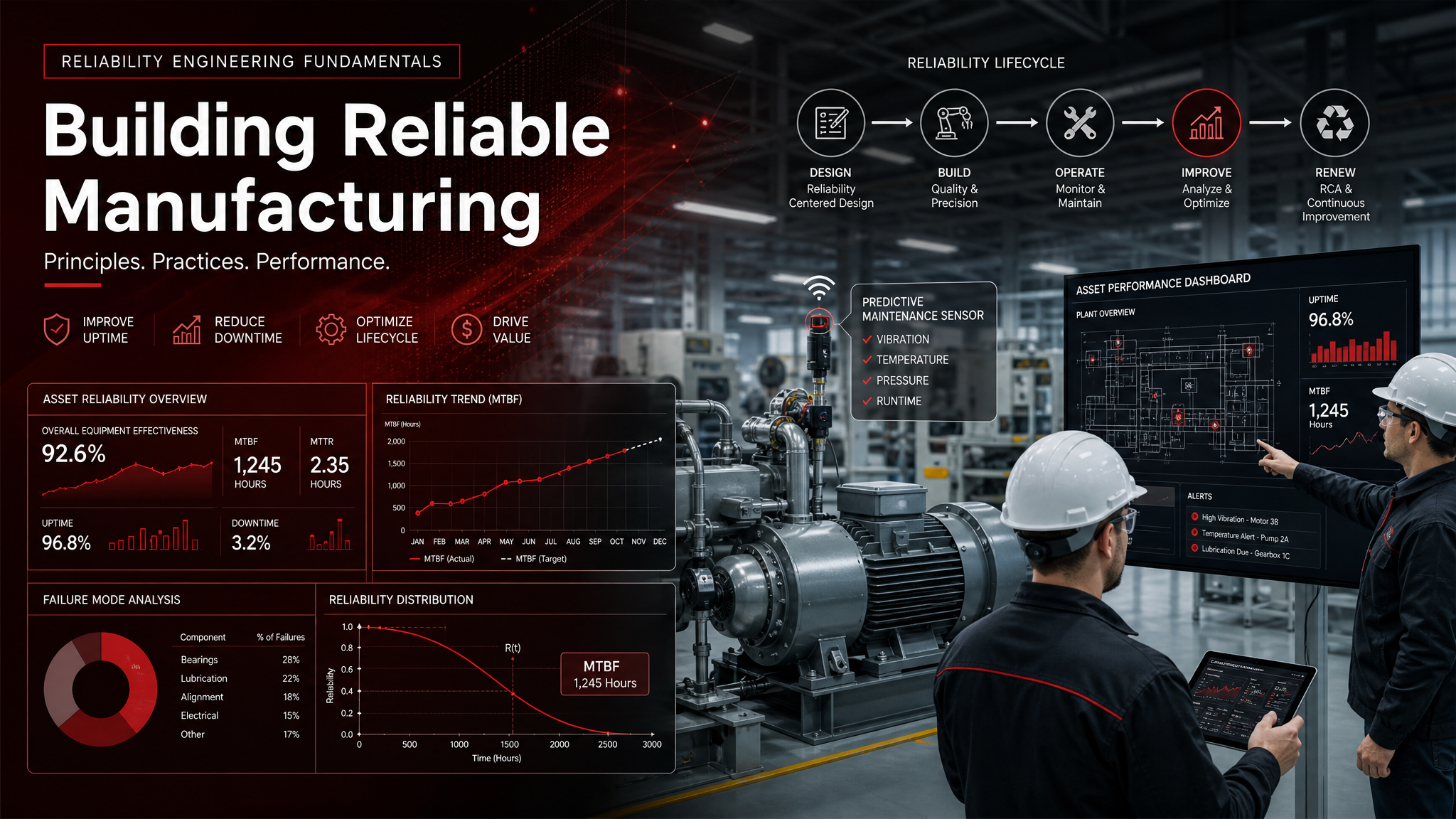
Reliability Engineering in Manufacturing: The Complete Guide to Maximizing Asset Uptime and Reducing Unplanned Failures
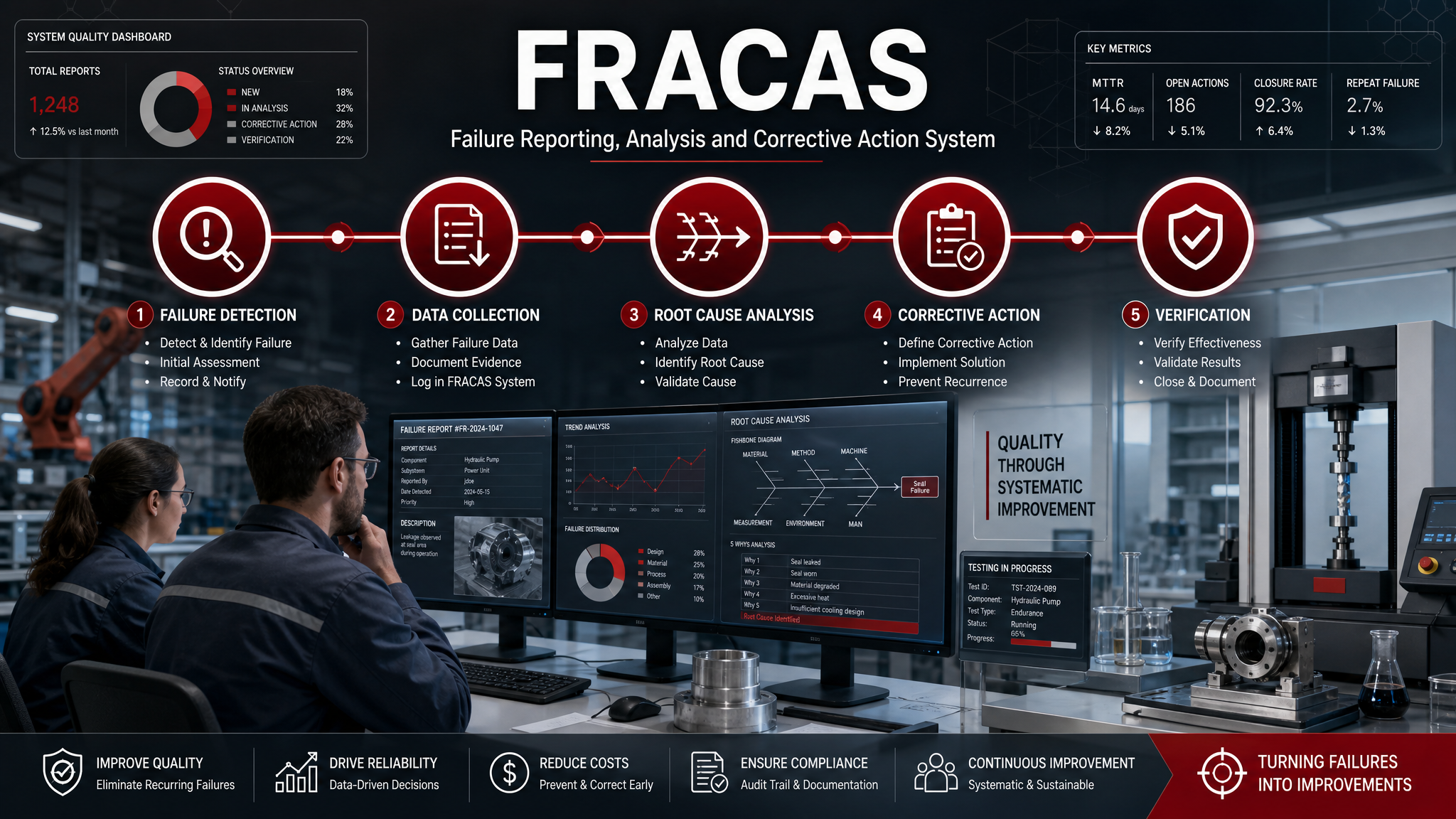
FRACAS Explained: How to Build a Failure Reporting, Analysis, and Corrective Action System That Drives Reliability Improvement