ISO 9001:2015 Complete Implementation Guide: From Gap Analysis to Certification
A comprehensive, step-by-step roadmap for implementing ISO 9001:2015 in your manufacturing organization — covering gap analysis, documentation, process mapping, and certification audit preparation.
John Lee
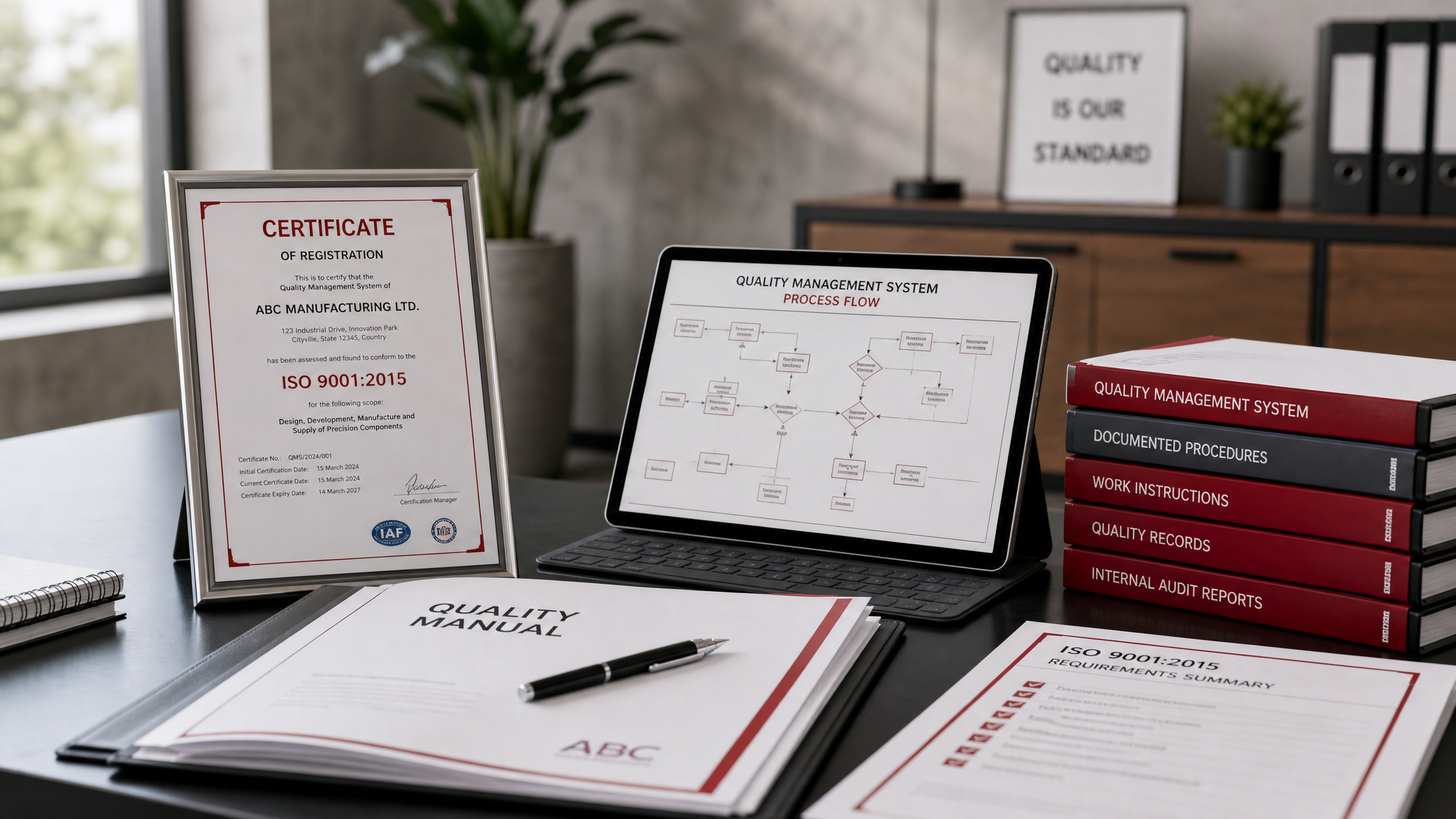
Illustrative image generated using AI; any people depicted are not real individuals.
Implementing ISO 9001:2015 is one of the most impactful decisions a manufacturing organization can make. Beyond the certificate on the wall, a well-implemented quality management system transforms how your organization operates — reducing waste, improving consistency, and building customer confidence.
Understanding the ISO 9001:2015 Framework
ISO 9001:2015 is built on seven quality management principles: customer focus, leadership, engagement of people, process approach, improvement, evidence-based decision making, and relationship management. Unlike earlier versions, the 2015 revision emphasizes risk-based thinking and gives organizations more flexibility in how they document their systems.
The standard follows the High-Level Structure (HLS) — also known as Annex SL — which makes it compatible with other management system standards like ISO 14001 (Environmental) and ISO 45001 (Occupational Health & Safety).
Phase 1: Gap Analysis (Weeks 1–3)
Before you begin building your QMS, you need to understand where you stand today. A thorough gap analysis compares your current practices against each clause of ISO 9001:2015.
- Clause 4 – Context of the Organization: Have you identified internal and external issues affecting your QMS? Are interested parties documented?
- Clause 5 – Leadership: Is top management demonstrating commitment? Is a quality policy established and communicated?
- Clause 6 – Planning: Are risks and opportunities identified? Are quality objectives measurable and aligned with your policy?
- Clause 7 – Support: Are resources adequate? Is competence managed? Are documents controlled?
- Clause 8 – Operation: Are operational processes planned and controlled? Is design and development managed appropriately?
- Clause 9 – Performance Evaluation: Are you monitoring, measuring, and analyzing your QMS performance?
- Clause 10 – Improvement: Do you have processes for nonconformity management and continual improvement?
Phase 2: Documentation and Process Mapping (Weeks 4–12)
With gaps identified, the next step is building your documentation framework. The 2015 revision gives you significant flexibility here — you don't need a thick quality manual (it's no longer required). Focus on creating documents that actually help your team do their work.
Key documentation to develop includes your quality policy, process maps using the turtle diagram approach, standard operating procedures (SOPs) for critical processes, and forms and templates for recording quality data.
Use the process approach to map interactions between departments. Every process should have defined inputs, outputs, resources, and performance indicators. This interconnected view helps your team understand how their work affects the entire quality chain.
Phase 3: Implementation and Training (Weeks 8–20)
Roll out your new processes department by department. Start with areas that had the most significant gaps. Conduct hands-on training — not just classroom sessions — so teams can practice using new forms, procedures, and tools in their actual work environment.
Key implementation activities include deploying your document control system, establishing your corrective action process, implementing management review meetings, setting up monitoring and measurement systems, and training internal auditors.
Phase 4: Internal Audit and Management Review (Weeks 16–24)
Internal audits are your dress rehearsal for certification. Conduct at least one complete audit cycle covering all QMS processes before your certification audit. Use your findings to drive corrective actions and demonstrate continual improvement.
Management review should analyze audit results, customer feedback, process performance data, and the status of actions from previous reviews. This is where leadership demonstrates their commitment to the QMS.
Phase 5: Certification Audit (Weeks 20–30)
The certification audit typically occurs in two stages. Stage 1 is a documentation review — the auditor verifies your QMS documentation meets the standard's requirements. Stage 2 is the implementation audit — the auditor verifies your processes are working as documented.
Prepare your team by conducting mock audits, reviewing common nonconformities, and ensuring all records are current and accessible. Remember, the auditor is looking for evidence that your system is effective, not that it's perfect.
Sustaining Your QMS After Certification
Certification is the beginning, not the end. Schedule regular internal audits, conduct management reviews at planned intervals, and use your corrective action process to address issues as they arise. The most successful organizations treat their QMS as a living system that evolves with their business.
Frequently Asked Questions
How long does ISO 9001:2015 implementation typically take?
What are the mandatory documented procedures in ISO 9001:2015?
Can a small manufacturer afford ISO 9001 certification?
About the Author
John Lee
Founder & Quality Systems Architect
John Lee brings over 20 years of hands-on experience in quality management across automotive, aerospace, and medical device manufacturing. As the founder of IntelligentQMS, he has helped organizations worldwide implement robust quality management systems that drive operational excellence.