Predictive Quality Analytics: Using Data to Prevent Defects Before They Occur
Learn how predictive analytics and machine learning are enabling manufacturers to shift from reactive defect detection to proactive defect prevention.
John Lee
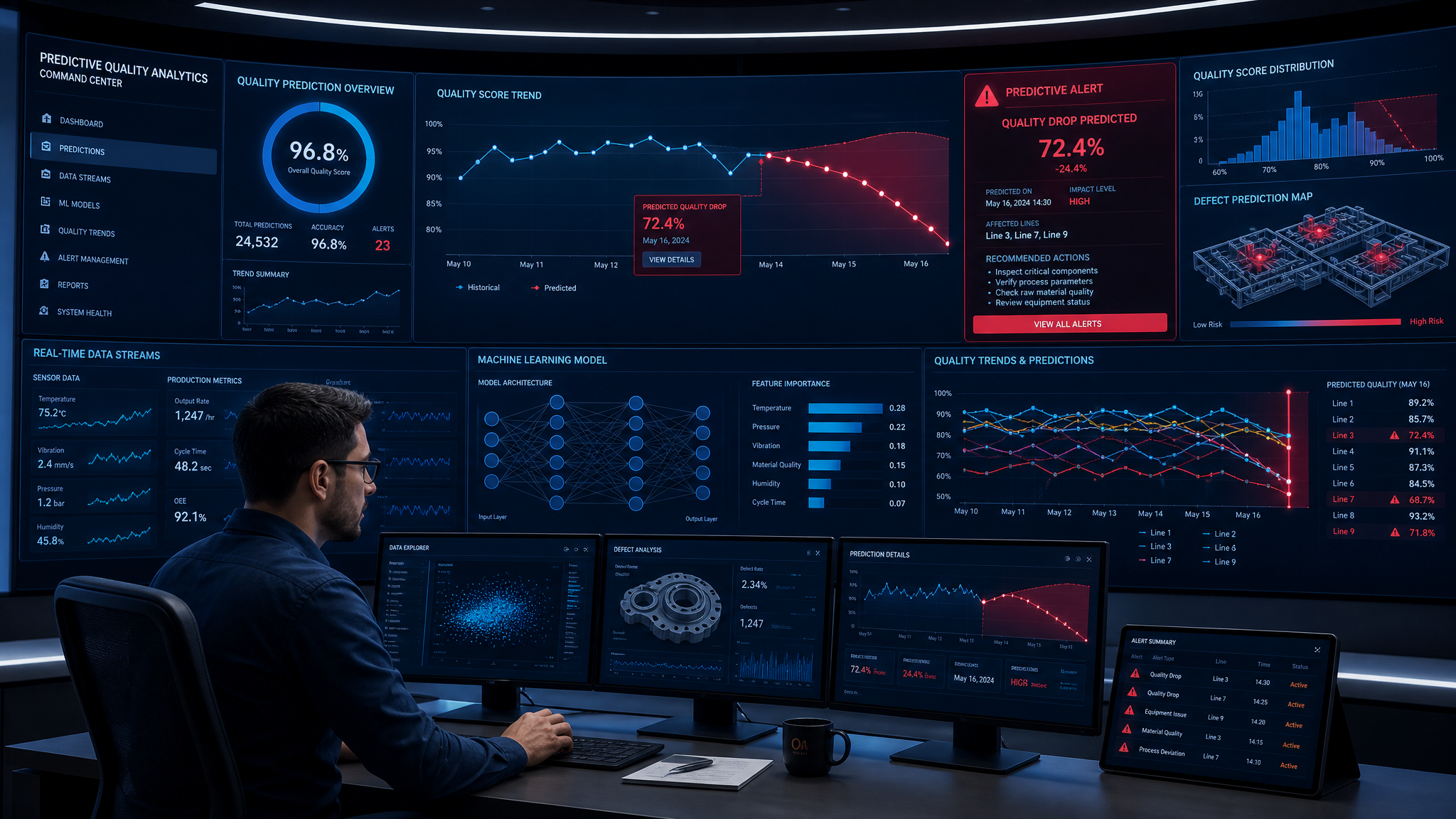
Illustrative image generated using AI; any people depicted are not real individuals.
Traditional quality management is inherently reactive — you inspect products, find defects, and then investigate what went wrong. Predictive quality analytics flips this model: by analyzing process data in real-time, manufacturers can identify conditions that lead to defects before those defects occur. This represents a paradigm shift in quality management — from detection to prevention.
The Evolution of Quality Analytics
Quality analytics has progressed through four stages, each building on the previous:
Descriptive: What happened? (Pareto charts, defect summaries, yield reports). Diagnostic: Why did it happen? (Root cause analysis, correlation studies). Predictive: What will happen? (Defect forecasting, risk scoring). Prescriptive: What should we do? (Automated parameter adjustments, recommended actions).
Most manufacturers today operate at the descriptive or diagnostic level. The competitive advantage lies in moving to predictive and prescriptive analytics.
How Predictive Quality Works
Predictive quality models use machine learning algorithms to identify patterns in your process data that correlate with quality outcomes. The basic approach involves collecting data from multiple sources across your process, training machine learning models on historical data where you know both the process conditions and the quality outcomes, deploying models to score incoming process data in real-time, and alerting operators or automatically adjusting parameters when the model predicts elevated defect risk.
Key Applications in Manufacturing
Process Parameter Optimization
Machine learning models can identify the optimal combination of process parameters (temperature, pressure, speed, etc.) that minimizes defect probability. This goes beyond traditional DOE (Design of Experiments) by continuously learning from production data and adapting to changing conditions.
Material Quality Prediction
By correlating incoming material properties with downstream quality outcomes, predictive models can flag incoming material lots that are likely to cause processing difficulties or quality issues — before those materials enter production.
Equipment Health and Quality Correlation
Predictive models can learn the relationship between equipment condition indicators (vibration, temperature, power consumption) and product quality. This enables quality-driven maintenance scheduling — servicing equipment when quality risk increases, not just when it breaks down.
Early Warning Systems
Real-time monitoring with predictive analytics creates an early warning system that detects process drift before it produces defective products. Traditional SPC identifies when a process has gone out of control; predictive analytics can identify when a process is trending toward instability, giving operators time to intervene.
Building Your Predictive Quality Capability
Start with your data infrastructure. You need reliable, granular data collection across your critical processes. Invest in sensors, automated data capture, and data integration before investing in advanced analytics.
Then start simple. Begin with straightforward correlation analysis between key process parameters and quality outcomes. Prove the concept with a pilot project before scaling. Build internal capability — your quality engineers need to understand and trust the models they're using.
Remember that predictive analytics is a complement to, not a replacement for, fundamental quality practices. It works best when built on a foundation of solid process control, capable measurement systems, and a culture of data-driven decision making.
Frequently Asked Questions
What data is needed for predictive quality analytics?
What is the difference between descriptive, diagnostic, and predictive analytics?
How accurate are predictive quality models in manufacturing?
About the Author
John Lee
Founder & Quality Systems Architect
John Lee brings over 20 years of hands-on experience in quality management across automotive, aerospace, and medical device manufacturing. As the founder of IntelligentQMS, he has helped organizations worldwide implement robust quality management systems that drive operational excellence.