FMEA in Manufacturing: A Practical Guide to Preventing Failures Before They Happen
Master Failure Mode and Effects Analysis (FMEA) with this practical guide covering DFMEA, PFMEA, the new AIAG-VDA methodology, and real-world implementation strategies.
John Lee
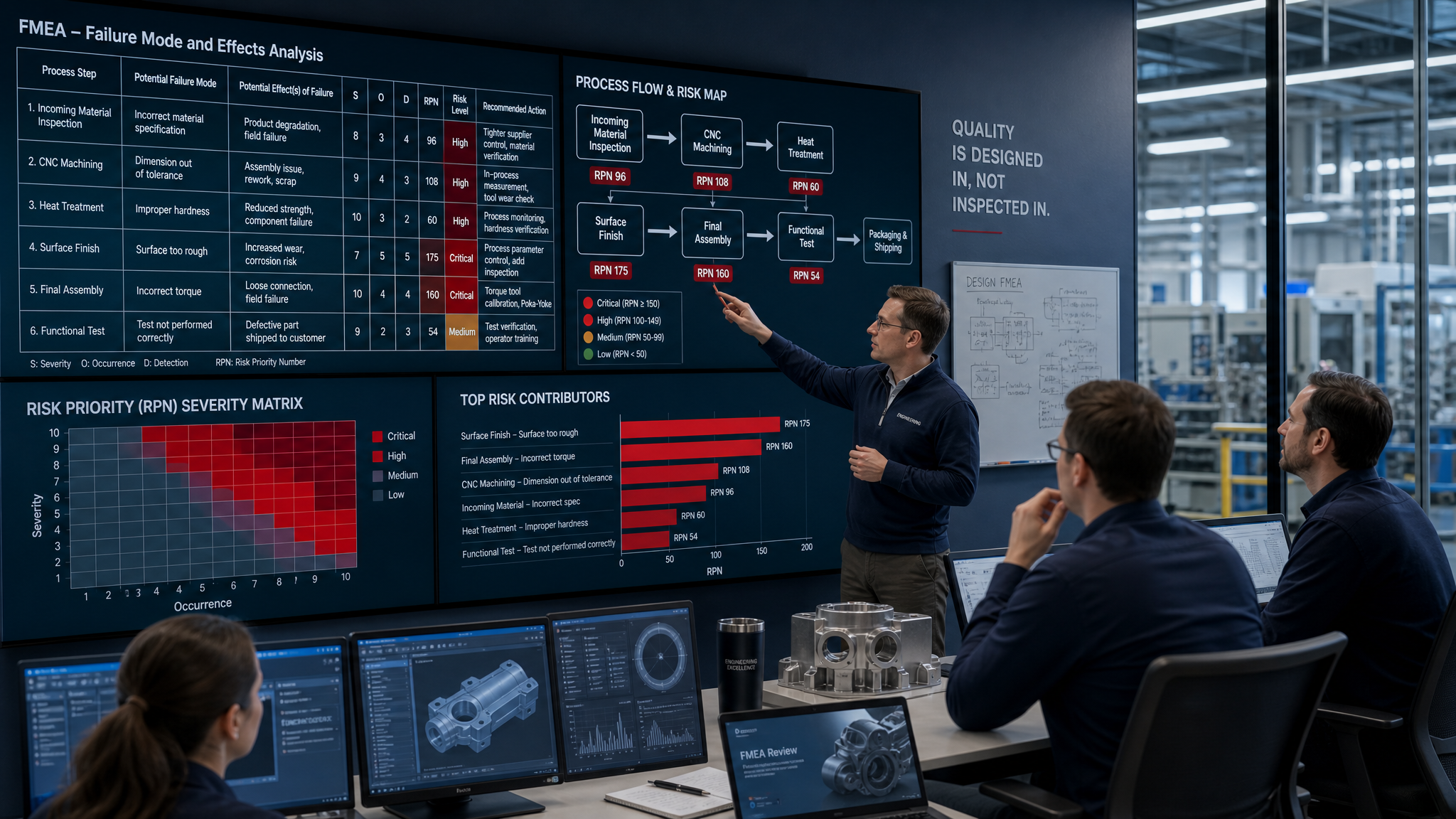
Illustrative image generated using AI; any people depicted are not real individuals.
Failure Mode and Effects Analysis (FMEA) is arguably the most powerful preventive quality tool available to manufacturers. When done well, it helps teams identify potential failures before they occur, prioritize risks, and implement controls that prevent defects from reaching customers. When done poorly, it becomes a paperwork exercise that adds no value.
Understanding the FMEA Framework
At its core, FMEA is a systematic method for identifying what could go wrong, understanding the consequences, and taking action to reduce risk. It applies to both product design (DFMEA) and manufacturing processes (PFMEA), and the most effective quality programs use both in an integrated approach.
The power of FMEA lies in its structured team-based analysis. It forces cross-functional teams to think critically about failure modes they might otherwise overlook, and it provides a framework for prioritizing improvement actions based on risk.
The AIAG-VDA 7-Step Approach
The harmonized AIAG-VDA FMEA methodology introduced in 2019 replaced the traditional RPN (Risk Priority Number) approach with a more structured 7-step process:
Step 1: Planning and Preparation
Define the scope, team composition, timeline, and ground rules for the analysis. Identify the product or process to be analyzed and gather relevant historical data.
Step 2: Structure Analysis
Break down the system into a hierarchical structure. For DFMEA, this means system → subsystem → component. For PFMEA, this means process → process step → process element (4M: Man, Machine, Material, Method).
Step 3: Function Analysis
Define the functions and requirements at each level of the structure. What is each element supposed to do? What are the performance requirements? This step creates the foundation for identifying failure modes.
Step 4: Failure Analysis
Identify failure modes (how the function can fail), failure effects (what happens when it fails), and failure causes (why it fails). Map these in a cause-failure-effect chain across the structural levels.
Step 5: Risk Analysis
Evaluate each failure chain using three criteria: Severity (S) of the effect, Occurrence (O) likelihood of the cause, and Detection (D) capability of current controls. Instead of calculating an RPN, the new methodology uses an Action Priority (AP) matrix that categorizes risks as High, Medium, or Low.
Step 6: Optimization
For High and Medium AP ratings, define specific improvement actions. Assign responsibility and target dates. Actions should address either the cause (prevention) or detection capability.
Step 7: Results Documentation
Document the completed analysis, including all actions taken and their effectiveness. Re-evaluate risk ratings after improvements are implemented.
Common FMEA Mistakes to Avoid
- One-person FMEA: FMEA is a team exercise. Having one person complete it alone defeats the purpose of cross-functional analysis.
- Copy-paste from previous projects: While reference FMEAs are useful, every product and process has unique risks that require fresh analysis.
- Inflated detection ratings: Teams often overestimate their ability to detect failures. Be honest about what your controls actually catch.
- No follow-through: The most common failure is identifying actions but never implementing them. Track actions to closure.
Integrating FMEA with Your QMS
FMEA should not exist in isolation. Connect it to your corrective action process (feed field failures back into FMEA updates), control plans (FMEA outputs should drive your control plan), incoming inspection (use FMEA to determine what to inspect), and training programs (high-risk process steps need enhanced operator training). When integrated properly, FMEA becomes the engine that drives proactive quality improvement across your entire operation.
Frequently Asked Questions
What is the difference between DFMEA and PFMEA?
What changed with the new AIAG-VDA FMEA methodology?
How often should FMEAs be updated?
About the Author
John Lee
Founder & Quality Systems Architect
John Lee brings over 20 years of hands-on experience in quality management across automotive, aerospace, and medical device manufacturing. As the founder of IntelligentQMS, he has helped organizations worldwide implement robust quality management systems that drive operational excellence.